If you have ever stared at a recipe that says "375°F, convection" and wondered whether your air fryer counts, you are not alone. The two appliances cook the same way on paper. In practice, they belong on very different parts of your counter and in very different parts of your week.
Here is how an air fryer and a convection oven actually compare, and how to pick the one that earns its space.
The short answer
An air fryer is a small, super-fast convection oven. Both circulate hot air with a fan to crisp food on the outside while cooking it through. The difference is scale and speed: an air fryer's basket is tight, the fan is closer, and the air moves faster, so a tray of fries finishes in 12 minutes instead of 25. A full-size convection oven holds a sheet pan, a roast, or a casserole, and uses gentler airflow over a much larger cavity.
If you cook for one or two people most nights, an air fryer is faster, cooler, and easier to clean. If you cook for a family or batch-prep on weekends, a convection oven moves more food at once.
Most kitchens benefit from both. If you only have room for one, this guide will tell you which.
How an air fryer actually works
An air fryer is a countertop chamber, usually 2 to 8 quarts, with a heating element on top and a high-speed fan that pushes air down and around a perforated basket. Because the basket is small and the airflow is aggressive, the surface of the food dries and browns quickly similar to what deep-frying does, with a fraction of the oil.
Three things make this work:
- Tight space. Less air to heat means the chamber hits temperature in under three minutes.
- Fast airflow. The fan moves air faster than a standard oven, so moisture leaves the food's surface before it can steam.
- Direct heat from above. The element is inches from the food, not feet away.
The result is the texture you want from frying — crisp shell, tender inside — without a pot of oil on the stove. Most modern units also include preset modes for roasting, baking, dehydrating, and reheating, which is why "air fryer" is becoming a misleading name. It is really a tabletop convection oven that happens to be very good at fries.

How a convection oven actually works
A convection oven is a full-size oven (built-in or countertop) with a fan and a third heating element in the back wall. The fan circulates hot air around the cavity so heat reaches the top, bottom, and sides of the food at the same temperature. Compared to a standard oven, convection cooks food about 25% faster and browns more evenly. King Arthur Baking recommends dropping the recipe temperature by 25°F when you switch a conventional recipe to convection.
The cavity is larger, typically 0.5 to 1.5 cubic feet for a countertop unit, 5 cubic feet or more for a built-in. That extra space is the trade-off. You can roast a full chicken, bake two sheet pans of cookies, or finish a casserole, but you spend longer preheating, you heat up the kitchen, and you wash a bigger interior.
The cooking principle is the same as an air fryer. The execution is slower and more spacious.
Where they really differ
Same physics, different daily reality.
Speed. An air fryer preheats in 2 to 3 minutes. A convection oven takes 8 to 12. For a weeknight side, that gap matters.
Capacity. An air fryer basket holds about 1 to 1.5 pounds of food in a single layer. A convection oven holds a half-sheet pan or a 4-pound roast. If you are feeding more than two people, an air fryer becomes a two-batch job.
Footprint. A 5-quart air fryer takes about a square foot of counter. A countertop convection oven takes two to three. A built-in convection oven takes none of your counter but commits a wall.
Heat in the room. A small chamber leaks less heat. In summer, the air fryer keeps the kitchen comfortable in a way the oven cannot.
Cleanup. Most air fryer baskets are non-stick and dishwasher-safe. A convection oven has racks, a fan grille, and a much bigger interior to wipe down.
Energy. Smaller cavity, shorter preheat, shorter cook time. An air fryer typically uses 50% to 70% less energy per meal than a full-size oven for the same dish.
Browning. Both brown well. The air fryer wins on small, dry foods (fries, wings, tofu, frozen snacks) because the airflow is more aggressive at close range. The convection oven wins on anything that needs even heat over a large surface such as sheet-pan dinners, two-pan cookie batches, roasts.
What each one cooks best
An air fryer is the right call for:
- French fries, sweet potato fries, tots
- Chicken wings and bone-in thighs
- Salmon fillets and shrimp
- Frozen apps (mozzarella sticks, dumplings, spring rolls)
- Reheating pizza without a soggy crust
- Roasted vegetables for one or two people
- Bacon, with no splatter on the stovetop
A convection oven is the right call for:
- Whole roast chicken or turkey breast
- Sheet-pan dinners for four or more
- Two pans of cookies at once
- Casseroles and lasagnas
- Bread and pastry, where rise and even browning matter
- Anything that needs to fit on a half-sheet pan
Both can roast a small batch of broccoli. Only one can roast a 14-pound turkey.
A note on food safety: regardless of which appliance you use, internal temperature is what cooks food, not the timer. The USDA's Safe Minimum Internal Temperature chart is the reference: 165°F for poultry, 145°F for whole-muscle beef, pork, and fish, with a three-minute rest. A $10 instant-read thermometer pays for itself the first week you own it.
Which one belongs on your counter
Use this as a quick decision rule.
Pick an air fryer if you:
- Cook for one or two people most days
- Want crispy textures without deep-frying
- Live in a small kitchen, apartment, dorm, RV, or office
- Hate preheating and waiting
- Already have an oven, even a basic one, for the bigger jobs
Pick a countertop convection oven if you:
- Cook for three or more people regularly
- Bake more than once a week
- Need a second oven for holidays or batch cooking
- Want one appliance that handles bakes, roasts, and broils
Get both if you:
- Cook a real dinner most nights
- Have the counter space (about 3.5 square feet between the two)
- Want the convection oven for the main, the air fryer for the side, in parallel
For the way most people actually cook through the week, the air fryer earns its space first. The oven you already have will handle the rest.
Our pick if you only have room for one
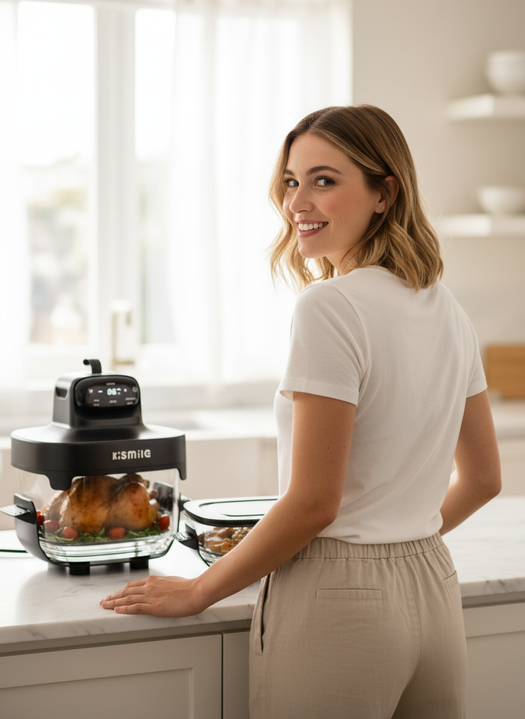
The Kismile 5-in-1 Portable Glass Air Fryer is the air fryer we recommend for buyers who want one appliance that pulls weeknight duty without taking over the counter. The glass bowl gives you a full view of what is cooking (no opening the basket every two minutes to check), the 5-in-1 modes cover air fry, roast, bake, dehydrate, and reheat, and it cleans up in the dishwasher.
If you want more on the Kismile lineup specifically, our team broke down why the Roasti Air Fryer earns counter space with same brand, larger basket, slightly different use case.
→ Shop the Kismile 5-in-1 Portable Glass Air Fryer
→ Browse the full Kismile collection or the rest of our kitchen appliances to round out the counter.