

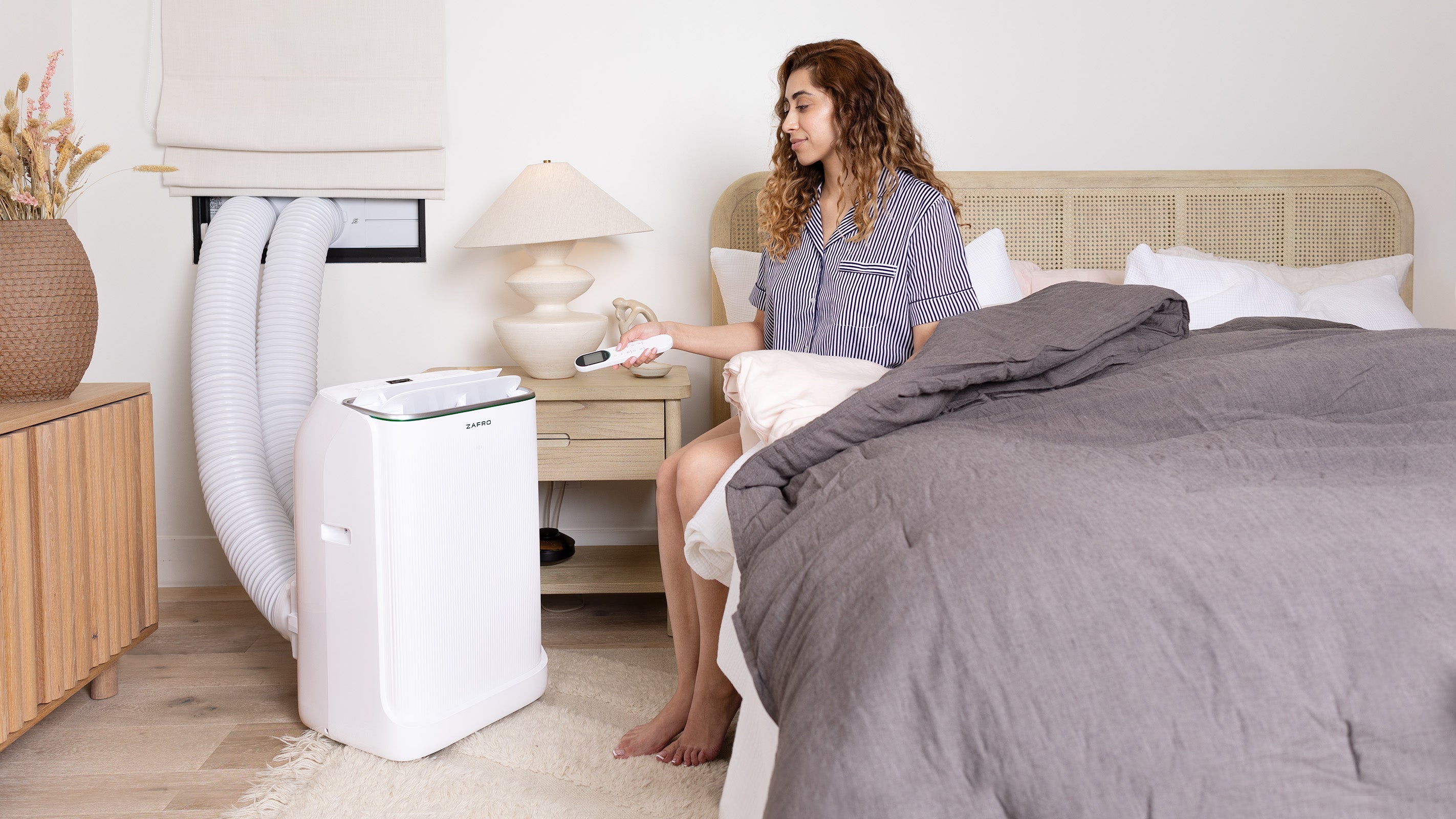
It is the first real heat wave of the summer, your bedroom feels like a parked car, and you are one click away from buying a portable air conditioner. Then the listings hit you with numbers: 8,000 BTU, 10,000 BTU, 14,000 BTU. Pick too low and the room never cools. Pick too high and you waste money on a unit that cycles on and off and leaves the air clammy. Matching BTU to room size is simple once you know the one rule and the one rating trap that trips most shoppers up.
Here is the short version. You need roughly 20 BTU of cooling for every square foot of room. A 300 square foot bedroom wants about 6,000 BTU. Measure the room, multiply, and you are most of the way there. The rest of this guide handles the details that decide whether your AC actually keeps up: the sizing chart, the two different ways BTU gets measured, and the room conditions that change the math.
The short answer: 20 BTU per square foot
The U.S. Department of Energy uses a baseline of about 20 BTU per square foot of living space to size a room air conditioner. To find your number:
- Measure the length and width of the room in feet.
- Multiply them to get square footage.
- Multiply square footage by 20.
A 12 by 15 foot bedroom is 180 square feet, so 180 times 20 is 3,600 BTU. Round up to the nearest size on the market, which is usually 5,000 to 6,000 BTU at the small end. This is the floor. Sun, ceilings, people, and kitchens push the number up, and we cover those adjustments below.
Room size to BTU chart
Use this as your starting point, then apply the adjustments in the next section.
| Room size | Cooling needed | Typical rooms |
|---|---|---|
| 100 to 150 sq ft | 5,000 BTU | Small bedroom, office, nursery |
| 150 to 250 sq ft | 6,000 BTU | Standard bedroom, home office |
| 250 to 350 sq ft | 8,000 BTU | Large bedroom, small living room |
| 350 to 450 sq ft | 10,000 BTU | Studio, open living area |
| 450 to 550 sq ft | 12,000 to 14,000 BTU | Large living room, open-plan space |
For most apartments and bedrooms, the sweet spot lands between 6,000 and 12,000 BTU. If your space spans an open kitchen-living layout, size for the total square footage you want cool, not just the room the unit sits in. For a closer look at cooling a smaller footprint, our guide to the best appliances for apartments and dorms walks through compact setups room by room.
The rating trap: ASHRAE BTU vs DOE SACC
This is the part that catches even careful shoppers. Portable air conditioners are often listed with two different BTU numbers, and they are not the same.
- ASHRAE BTU is the older, higher number. It measures cooling under ideal lab conditions and tends to overstate real-world performance.
- DOE SACC (Seasonally Adjusted Cooling Capacity) is the newer standard the Department of Energy requires on the EnergyGuide label. It accounts for the heat a portable unit pulls back in through its exhaust and duct, so it reflects how the unit performs in your actual room.
The SACC number runs 20 to 40 percent lower than the ASHRAE number. You can see this on a real spec sheet: the ZAFRO CorePro is listed at 8,000 to 10,000 BTU, with a DOE rating of 5,000 to 6,000 BTU SACC right next to it. That gap is exactly why so many people feel their new AC is underpowered. They sized the room off the big marketing number instead of the realistic one.

The simple rule: when you compare the 20 BTU per square foot target against a product, match it to the DOE SACC rating where it is listed. It also explains why a unit advertised at "14,000 BTU," like the ZAFRO ComfortAir, is positioned for bedrooms, offices, and smaller apartments rather than a 700 square foot great room. Its real-world capacity sits below the headline figure.
Adjust for your actual room
The 20 BTU rule assumes an average room with average sun and two people. Real rooms vary. Apply these adjustments to your base number:
Sunny rooms: add 10 percent. A bedroom with big west-facing windows that bake all afternoon needs more cooling than the chart suggests. Heavily shaded rooms can subtract 10 percent.
Extra people: add 600 BTU per person. Bodies give off heat. The base assumes two occupants, so add 600 BTU for each additional person who is regularly in the room.
Kitchens: add 4,000 BTU. The stove and oven add a serious heat load. Open-plan kitchen-living spaces are the most commonly undersized rooms.
High ceilings: size up a tier. The chart assumes standard 8 foot ceilings. Lofts and vaulted rooms hold more air, so move up one BTU level.
Stack these where they apply. A sunny 300 square foot living room that opens onto a kitchen and seats four can jump from a chart value of 6,000 BTU to well over 10,000 BTU once you add the sun, the people, and the kitchen.
What happens when you size it wrong
Sizing is not just about comfort. Getting it wrong costs you both ways.
Too small and the unit runs constantly, never reaches the temperature you set, and wears out faster while your electric bill climbs. The room stays warm and the compressor never rests.
Too big sounds safe, but an oversized AC cools the air fast and shuts off before it pulls out humidity. You get a room that feels cold and damp, with the unit short-cycling on and off. That clammy feeling is the classic sign of a unit that is too powerful for the space.
The right size cools steadily, pulls moisture out as it runs, and holds your set temperature without hammering the compressor.
Match your BTU to the right Zafro portable AC
Once you have your target number, picking the unit is the easy part. Here is how Rowan's Zafro portable air conditioners line up by room and need.
Small to mid-sized rooms, lowest price. The ZAFRO CorePro delivers 8,000 to 10,000 BTU (5,000 to 6,000 BTU SACC) with 3-in-1 cooling, dehumidifying, and fan modes, two fan speeds, and a sleep mode. At around $200, it is the budget entry for a bedroom, office, or nursery.
Bedrooms, offices, and dorms. The ZAFRO ComfortAir lists 14,000 BTU with 3-in-1 functionality, a 24-hour timer, auto-evaporative drainage, and 360 degree wheels so you can roll it room to room. Around $399.

Up to 550 square feet, quiet sleep. The ZAFRO ComfortFlow covers rooms up to 550 square feet at 12,000 to 14,000 BTU, with cooling, fan, and dehumidifier modes and quiet sleep operation at 52 dB or lower. Around $500.
Large or hot rooms that need to drop fast. Both EliteCool models add smart WiFi control, self-evaporative drainage, a washable filter, and energy-efficient R32 refrigerant. The ZAFRO EliteCool runs 12,000 to 14,000 BTU with whisper-quiet operation, around $525. The ZAFRO Bamboo EliteCool steps up to 14,000 to 16,000 BTU at a quiet 42 dB, around $520, and we cover it in detail in why the Bamboo EliteCool is the quiet cooling hero of the summer.

Measure your room, multiply by 20, check the result against the SACC rating where it is listed, and adjust for sun, people, and your kitchen. That five-minute process is the difference between a summer of steady comfort and a unit that never quite keeps up.
→ Ready to cool your space the right way? Shop portable air conditioners at Rowan Appliance and match your room size to the right BTU.


