

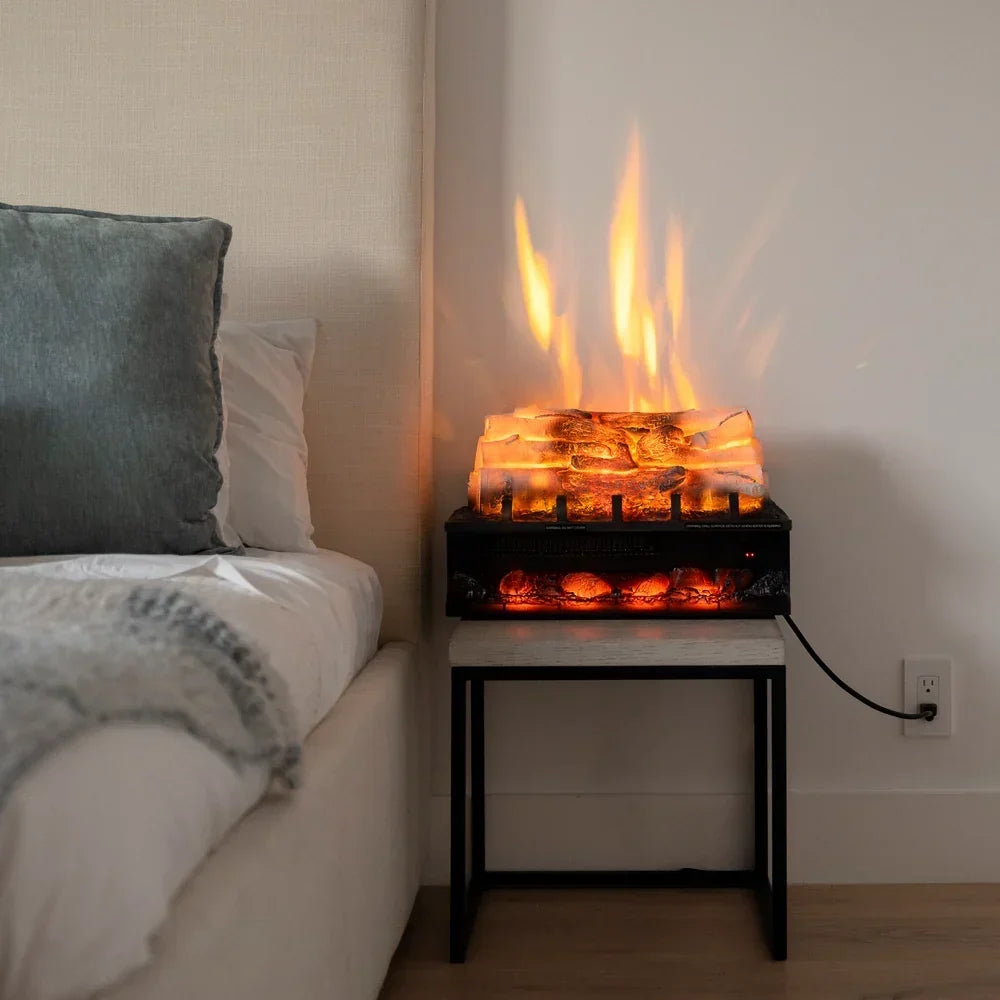
You have been eyeing an electric fireplace for the living room, and then you read a winter headline about space heater fires and stopped scrolling. Fair reaction. Most product pages skip past the risk question entirely.
Electric fireplaces remove the dangers people worry about most. They also introduce one that gets ignored, and it is worth understanding before you plug anything in.
Safer than a real fire, still a real heater
An electric fireplace is one of the safer ways to add heat to a room. There is no combustion, so there is no carbon monoxide, no smoke, no flue to maintain, and no embers to escape onto a rug. The flame you see is light on a screen or a reflective surface.
But an electric fireplace is still an electric heater. Most of them pull 1,500 watts on high, the same as a portable space heater, and they carry the same electrical risks. That is the part worth taking seriously.
What an electric fireplace cannot do
Three of the classic fireplace hazards are simply off the table.
There is no carbon monoxide, because nothing burns. Gas and wood fireplaces produce CO as a byproduct of combustion, which is why they need venting and why CO detectors matter in those rooms. An electric unit converts electricity to heat and light, and produces no exhaust gas at all.
There is nothing to vent, which means no chimney, no annual sweep, and no creosote building up somewhere you cannot see. This is why electric models work in apartments and finished basements where a real fireplace would never pass inspection.
There are no sparks or embers. The flame effect on the R.W.FLAME Electric Fireplace Insert Log Heater is LED light playing across a molded log set. You can touch the "flames." Nothing in that assembly can pop out onto your floor.
People also ask whether the units are toxic or off-gas anything. New electric fireplaces sometimes give off a faint plastic or dust smell during the first few hours of use, as manufacturing residue burns off the heating element. It fades and it is normal. If a burning smell persists past the first few uses, unplug the unit and contact the manufacturer.
What it can still do
The National Fire Protection Association tracks home heating fires, and the numbers are lopsided in a way that surprises people.
Between 2020 and 2024, US fire departments responded to an average of 37,365 home fires per year involving heating equipment. Those fires caused 417 civilian deaths, 1,260 injuries, and $1.2 billion in property damage annually. According to the NFPA, space heaters and heating stoves accounted for about 30 percent of those fires, but 73 percent of the deaths and 70 percent of the injuries.
Read that ratio again. Space heaters cause under a third of heating fires and nearly three quarters of the deaths. December, January, and February are the peak months.
An electric fireplace sits in that category. The technology is not what drives those numbers. How people use plug-in heaters is: pushed against furniture, run off an extension cord, left going in an empty room.
The five things that actually cause problems
Almost every electric heater incident traces back to one of these.
- Extension cords and power strips. This is the big one. A 1,500 watt heater draws about 12.5 amps continuously. Most household extension cords and nearly all power strips are not rated for a sustained load like that, and the cord itself becomes the failure point. Plug an electric fireplace directly into a wall outlet. Every manufacturer says this, including in the R.W.FLAME manuals, and it is the single instruction most often ignored.
- Blocked air intake. Fan-forced units pull cool air in through a vent, usually on the bottom or back, and push warm air out the front. Block the intake with a blanket, a stack of magazines, or a couch pushed too close, and heat builds inside the housing. Good units have overheat protection that cuts power when this happens. That protection is a backstop, not a license to crowd the unit.
- Fabric and clearance. The NFPA three-foot rule applies here: keep anything that can burn at least three feet from the heater. Curtains, throw blankets, a dog bed, holiday stockings hung across the front of a mantel unit. Wall-mount and recessed models help a lot, since they sit off the floor and out of the path of soft furnishings.
- Damaged or warm cords. Check the plug occasionally. If the plug or outlet feels hot to the touch, or the cord is cracked or pinched behind furniture, stop using it. A warm plug means resistance somewhere in the connection, and resistance means heat.
- Old or uncertified units. Look for a UL, ETL, or CSA listing mark. That means an independent lab tested the unit against a recognized safety standard, and it is the easiest quality filter available to a shopper.
Can you leave an electric fireplace on overnight?
Flame effect only, yes. The LED flame draws roughly 10 to 20 watts, about the same as a small lamp, and produces almost no heat. Plenty of people run it as ambient light all evening.
Heat on and unattended, no. A well-built unit probably will not fail, but safety cutoffs work best when someone is awake to notice they tripped. If you want warmth overnight, use a model with a timer or thermostat and let it shut itself off. The R.W.FLAME Wall-Mount/Recessed Electric Fireplace has an 8-hour timer and a sleep mode for exactly this reason.
Are electric fireplaces safer than space heaters?

Generally yes, for reasons that have more to do with design than technology.
A portable space heater sits on the floor, gets bumped, gets moved from room to room, and often ends up near the thing it should not be near. A wall-mounted or recessed electric fireplace is fixed in place, elevated off the floor, and cannot be knocked over. A mantel unit is heavy and stays put.
Both draw the same 1,500 watts. The fireplace is just harder to misuse.
Electric fireplaces and carpet
This one comes up constantly. Freestanding electric fireplaces are fine on carpet. The cabinet does not get hot enough to scorch, and the heat blows forward rather than down.
Two caveats. Make sure a low-mounted air intake is not sitting flush against thick carpet or a shag rug, since that is the blocked-intake problem again. And do not run the cord under the rug, where it can be crushed underfoot without you noticing.
You do not need a hearth pad or a heat shield underneath. That is a wood-burning requirement.
Do they actually heat a room?
Yes, within limits, and the limit is set by physics rather than by brand.
A standard 120-volt outlet caps a heater at about 1,500 watts, which converts to roughly 5,100 BTU per hour. That is why nearly every plug-in electric fireplace on the market, including all of the R.W.FLAME models, is rated at the same 5,100 BTU. Anyone advertising dramatically more heat from a standard plug is measuring something else.
In practice, 5,100 BTU comfortably warms a room up to about 400 square feet. It is supplemental heat for the room you are sitting in, not a furnace replacement for the house.
What to look for when you buy
Four features do most of the safety work, and none of them are exotic.
- Overheat protection. Cuts power automatically if internal temperature climbs, which covers the blocked-intake scenario.
- A timer or thermostat. The unit stops on its own instead of running all night.
- Cool-touch glass. Matters if you have small kids or pets at eye level with the front panel.
- A safety listing mark. UL, ETL, or CSA tells you a lab actually tested it.
Rowan's R.W.FLAME lineup covers the range. The Electric Fireplace Insert Log Heater is $110 right now, down from $179.99, with overheat protection, a remote, five flame brightness levels, and quiet operation at 40 dB or under. The Wall-Mount/Recessed Electric Fireplace starts at $130.66, comes in sizes from 30 to 68 inches, fits a standard 2x6 stud bay for a flush built-in look, and adds the 8-hour timer and 12 flame colors. The 36-inch Electric Fireplace with Mantel is $285 and brings cool-touch glass plus thermal overload protection, which is the combination worth having in a room where kids play. If a flush built-in is the look you want, the recessed fireplace collection groups the sizes that fit a standard stud bay.
Three rules and you are done

Electric fireplaces are safe in the ways that scare people and require ordinary care in the ways that do not make headlines. You are not managing carbon monoxide, a flue, or stray embers. You are managing a 1,500 watt appliance that wants its own wall outlet, three feet of clear space, and an unblocked path for air.
Do those three things and the risk drops to about that of running a lamp.


