

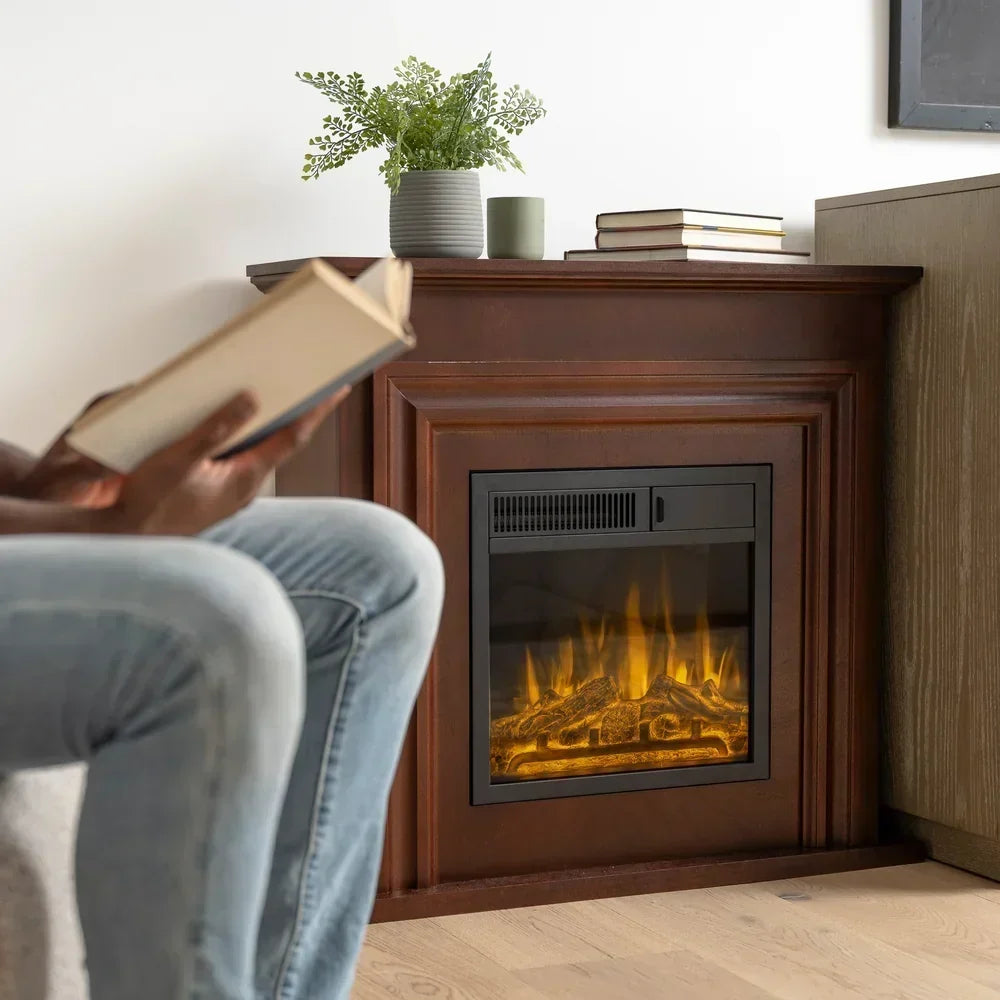
The flame costs less than most people expect. The heat costs more. That gap is wide enough to be worth pinning down before your first winter bill, so every figure below uses current US electricity rates.
The only spec that matters
Forget the marketing copy for a second. An electric fireplace has one number that determines what it costs to run: wattage.
Nearly every plug-in model has two settings, 750 watts and 1,500 watts, plus a flame-only mode that draws roughly 10 to 20 watts. The R.W.FLAME lineup follows this pattern, as does almost everything else designed for a standard 120-volt outlet.
Wattage times hours gives you kilowatt-hours, and kilowatt-hours are what your utility bills you for.
What it costs per hour
The US average residential electricity price was 18.44 cents per kilowatt-hour in May 2026, according to the Energy Information Administration. At that rate:
| Mode | Power draw | Cost per hour |
|---|---|---|
| Flame effect only | About 15 W | About 0.3 cents |
| Heat on low | 750 W | About 14 cents |
| Heat on high | 1,500 W | About 28 cents |
Running the heat on high costs roughly the same as running a hair dryer, which makes sense, because it is roughly the same appliance underneath.
What it costs per month
Nobody runs a fireplace 24 hours a day. Four hours an evening through a cold stretch is realistic. Over a 30-day month:
| Usage | Energy used | Monthly cost |
|---|---|---|
| Flame only, 8 hours a day | 3.6 kWh | About 66 cents |
| Flame only, all day every day | 10.8 kWh | About $2 |
| Heat on low, 4 hours a day | 90 kWh | About $17 |
| Heat on high, 4 hours a day | 180 kWh | About $33 |
Across a full December through February at four hours a day on high, you are looking at roughly $100 for the season.
Your rate is probably not the national average, though. Electricity runs well under 15 cents per kilowatt-hour in parts of the South and well over 30 cents in Hawaii, California, and much of New England. Check the "price per kWh" line on your bill and redo the math with your own number.
Flame-only mode is nearly free
This is the part people get wrong in both directions.
The LED flame effect is lighting, not heating. At around 15 watts it draws about as much as a small lamp. You can leave it on every evening from October to March and the total will land somewhere near the cost of a cup of coffee.
So if what you actually want is the look of a fire in the room, the ambiance costs almost nothing. It is only when you switch the heating element on that the meter starts moving.
Why every electric fireplace puts out the same heat

This one saves you from paying extra for a spec that does not exist.
A standard US wall outlet on a 15-amp circuit safely supports about 1,500 watts of continuous load. One watt equals 3.412 BTU per hour, so 1,500 watts converts to roughly 5,118 BTU per hour. That is the ceiling for anything that plugs into a normal outlet.
This is why the R.W.FLAME Wall-Mount/Recessed Electric Fireplace, the Electric Fireplace Insert Log Heater, and the 36-inch model with mantel are all rated at 5,100 BTU despite different sizes and prices. A 60-inch unit does not heat more than a 30-inch unit. It just looks bigger and spreads the same heat across a wider opening.
At 5,100 BTU you can expect to warm a room up to about 400 square feet. What you pay more for as you move up the range is size, finish, installation style, and features, not heating power.
Does it actually save money on heating?
Sometimes, and the condition attached to that answer matters more than the answer.
Electric resistance heat is 100 percent efficient at the point of use. Every watt becomes heat in your room, with nothing lost up a flue. That sounds unbeatable, and it is a genuine advantage over a vented fireplace that sends much of its heat outside.
But efficiency is not the same as cost. Per unit of heat delivered, electricity is more expensive than natural gas in most of the country. Swapping your furnace for an electric fireplace and heating the same space will cost you more, not less.
Zone heating is what makes the math work. If you spend the evening in one room, turning the central thermostat down several degrees and warming only that room with a 1,500 watt fireplace can genuinely come out ahead, because you have stopped paying to heat bedrooms and hallways nobody is in.
The condition is the thermostat. If you run the fireplace and leave the furnace where it was, you have added about $33 a month to your bill and saved nothing. The savings come from heating less of the house, not from cheaper heat.
Four ways to cut the cost
- Use the 750 watt setting first. It halves the cost per hour and is often plenty for a small or well-insulated room. Most people default to high out of habit and never test whether low is enough.
- Let the timer do the work. A model with a shutoff timer, like the wall-mount unit's 8-hour setting, stops you from heating an empty room after everyone goes to bed.
- Run flame-only when you want the look. Most evenings the appeal is the glow, not the warmth. That mode costs essentially nothing.
- Turn the central thermostat down when the fireplace is on. This is the step that converts zone heating from a nice idea into an actual line-item saving.
Work out your own number
The formula is short enough to do on your phone:
(watts ÷ 1,000) × hours used × your rate per kWh = cost
A 1,500 watt unit running 3 hours at 22 cents: 1.5 × 3 × 0.22 = 99 cents for the evening.
Where to start

If the goal is ambiance with heat available when you want it, the R.W.FLAME Electric Fireplace Insert Log Heater is $110, down from $179.99, and drops into an existing fireplace opening with no construction. Five flame brightness levels, a remote, and quiet operation at 40 dB or under.
For a built-in look, the Wall-Mount/Recessed model starts at $130.66 and comes in 30 through 68-inch sizes. It fits a standard 2x6 stud bay, offers 12 flame colors, and includes the 8-hour timer that keeps the running cost honest. Rowan also groups the flush-fit sizes in a recessed fireplace collection if that is the install you have in mind.
If you want a freestanding piece that needs no installation at all, the 36-inch Electric Fireplace with Mantel is $285, down from $359.99, with cool-touch glass and seven brightness levels.
What a winter actually costs
The flame is nearly free. The heat costs about 28 cents an hour on high and half that on low. A realistic winter of evening use lands near $100, and it only lowers your total bill if you turn the thermostat down to match.
For most people that is a reasonable trade for a warm room and a fire you never have to clean up after.
Before you plug one in, it is worth reading are electric fireplaces safe for the wiring rules that matter at 1,500 watts.


