

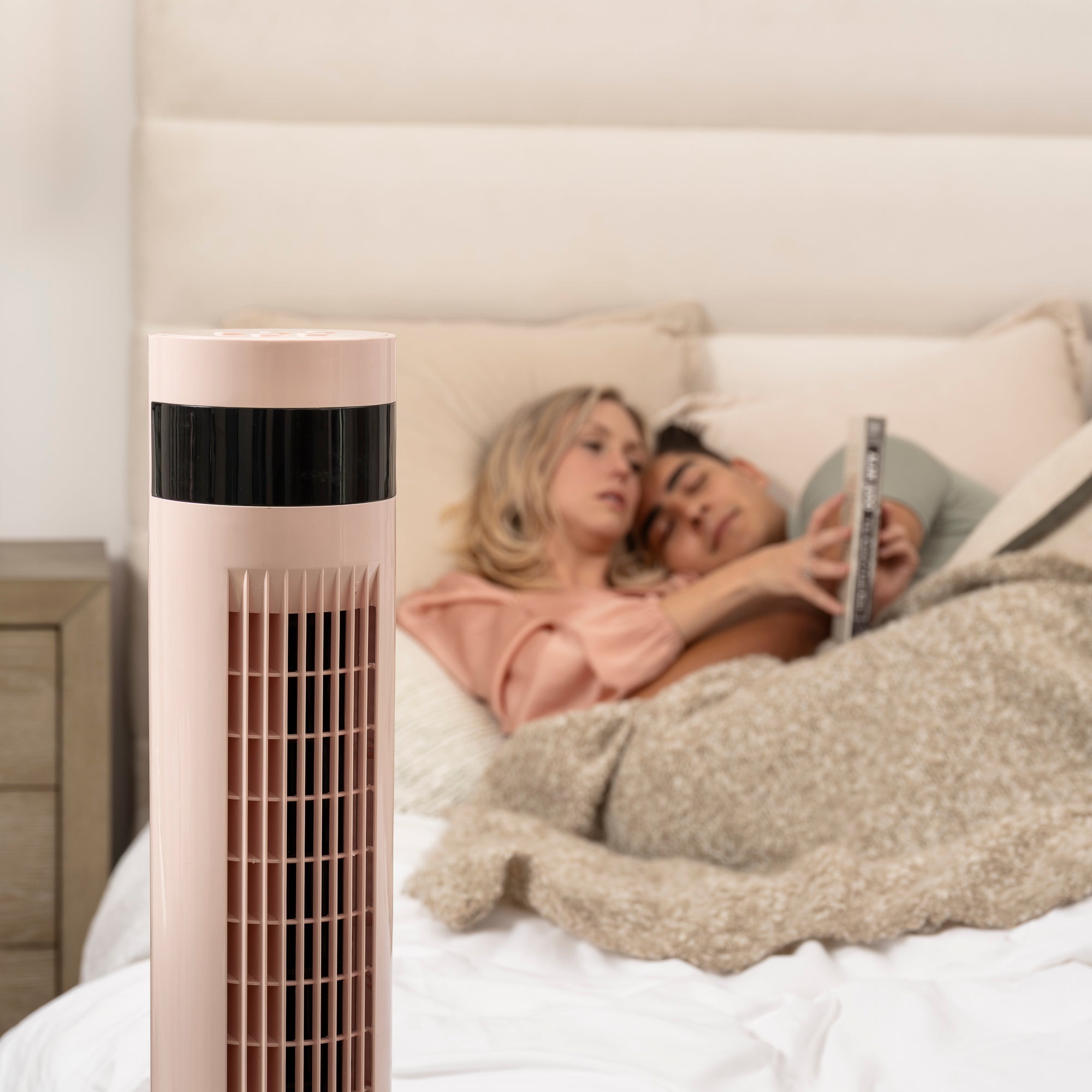
It is the third week of July, your bedroom holds heat until well past midnight, and you are standing in a store aisle looking at two fans that cost about the same. One is a slim column. The other is a round head on a stick. Nobody has explained the difference to you in terms that help.
On tower fan vs pedestal fan, a pedestal fan moves more air and moves it farther, so it wins in large or open rooms. A tower fan takes up less floor space, runs quieter at low speeds, and directs air across a wider vertical band, so it wins in bedrooms and small rooms where you sleep near it. Neither one lowers the temperature of your room. They both work by moving air across your skin, which becomes a problem above a certain temperature.

The airflow question, answered honestly
Pedestal fans generally move more air.
A pedestal fan uses a large exposed blade, often 16 to 20 inches across, spinning in open space. A tower fan uses a tall, narrow cylindrical impeller inside a housing. The pedestal design simply has more room to work with, and the consumer testing group CHOICE found in its own lab testing that pedestal fans generally have more powerful airflow than tower fans.
So if your goal is to push air across a 400 square foot living room, or to move air from one room toward another, a pedestal fan is the better tool. We do not sell pedestal fans, and that is still the right answer.
Where the comparison flips is when raw airflow stops being the thing you are optimizing for.
Where tower fans win
- Floor space. A pedestal fan needs a stable base, usually a circle 15 to 18 inches wide, and it needs clearance around the head to oscillate. A tower fan occupies roughly the footprint of a shoebox. In a bedroom with a nightstand, a dresser, and a path to the door, that difference decides whether the fan is usable or whether it becomes something you walk around for four months.
- Noise at low speed. A large blade at low RPM produces a rhythmic thumping as each blade passes the housing. Tower fans, especially bladeless designs, produce a steadier and less rhythmic sound. Neither is silent. But steady noise disappears into the background while rhythmic noise keeps pulling your attention back, which is why tower fans tend to be easier to sleep next to.
- Vertical coverage. A pedestal fan aims a concentrated circle of air at roughly one height. A tower fan pushes air along its full column, so it covers you from about knee height to chest height at once. Sitting on a couch or lying in bed, that wider band feels more even than a single targeted stream.
- Safety around kids and pets. An exposed spinning blade behind a wire cage is a curiosity. A smooth column is not. The Antarctic Star Oscillating Tower Fan uses a bladeless design at $49.99, which removes the question entirely.
- Looks. This is a real reason and people are shy about saying it. A slim column blends in with the furniture in a way an exposed blade on a stick does not.
The bedroom case
If you are buying a fan specifically for sleeping, the calculus narrows.
You are not trying to cool the room. You are trying to keep air moving across your skin at a steady rate, quietly, without waking yourself up to adjust it. That means three features matter more than airflow numbers.
- A genuine low setting. Many fans have a low speed that is still too loud for a quiet bedroom. Look for a dedicated sleep or night mode that steps the speed down rather than just running speed one.
- A timer. Rooms cool off overnight. Running a fan at the same speed at 3 a.m. as at 11 p.m. often means waking up cold at 4 a.m.
- A remote. Getting out of bed to change a setting is how a fan ends up staying on one speed all summer.
The Antarctic Star 3-Mode Oscillating Tower Fan covers all three at $94.99. It stands 43.3 inches, runs three speeds across three breeze modes, oscillates 85 degrees, and includes a timer, an LED display, and a remote. The height matters in a bedroom because at 43 inches the airflow crosses a mattress rather than passing over or under it. If you are working through the rest of the room, our bedroom collection groups the fans, mini fridges, and air conditioners that fit the same space.
What neither fan can do

This is the part most comparison articles leave out, and it is the part that affects your safety.
Fans do not cool air. They move it. You feel cooler because moving air speeds up the evaporation of sweat from your skin. When the air around you is hotter than your body, that mechanism stops helping and starts working against you.
The EPA is direct about it: "Do not use electric fans for cooling when the room temperature is in the mid-90s or higher." And it adds that "when it is that hot, electric fans will not prevent heat-related illness." The CDC gives a similar threshold, advising fans only when indoor temperatures are below 90°F, because above that a fan can raise body temperature rather than lower it.
So if your bedroom is sitting at 96°F at bedtime during a heat wave, the honest answer is that neither a tower fan nor a pedestal fan is the product you need. You need to actually lower the air temperature, which means a portable air conditioner. The ZAFRO CorePro Air Conditioner is the usual starting point at $199.99 for a single bedroom. If your room has no usable window, that is a solvable problem too, and we walk through it in how to cool a room without a window. A fan is the right purchase for a room in the 70s and 80s where you want air movement and lower energy use. It is the wrong purchase for a room in the mid-90s.
Many people run both, using a portable AC to bring the room down and a fan to distribute that cooled air, which uses less energy than running the AC harder.
How to choose in thirty seconds
- Buy a pedestal fan if: the room is large or open plan, you want to move air between rooms, you need to direct a strong stream at a specific spot, or you want maximum airflow per dollar.
- Buy a tower fan if: floor space is tight, you are sleeping in the room, there are kids or pets around, you want it to disappear into the decor, or you want even coverage rather than a concentrated blast.
- Buy neither if: the room regularly sits above 90°F, in which case put the money toward cooling the air instead.
For most bedrooms, home offices, and apartments, which is where most people are actually shopping, the tower fan is the better fit. For a garage, a workshop, a large living room, or a patio, get the pedestal.
One last thing
Whichever you buy, airflow drops as dust collects on the intake. A fan that seems weaker in its second summer is usually not failing. It is clogged. Ten minutes with a vacuum brush on the intake grille restores most of what you lost, and it is worth doing before you conclude you bought the wrong fan.
If a slim, quiet, bedroom-friendly column is what your space calls for, the choice comes down to room size. The $49.99 Antarctic Star oscillating model handles a small room or a home office. The $94.99 43-inch version covers a full bedroom and adds the timer and remote that make it easier to live with overnight.


