

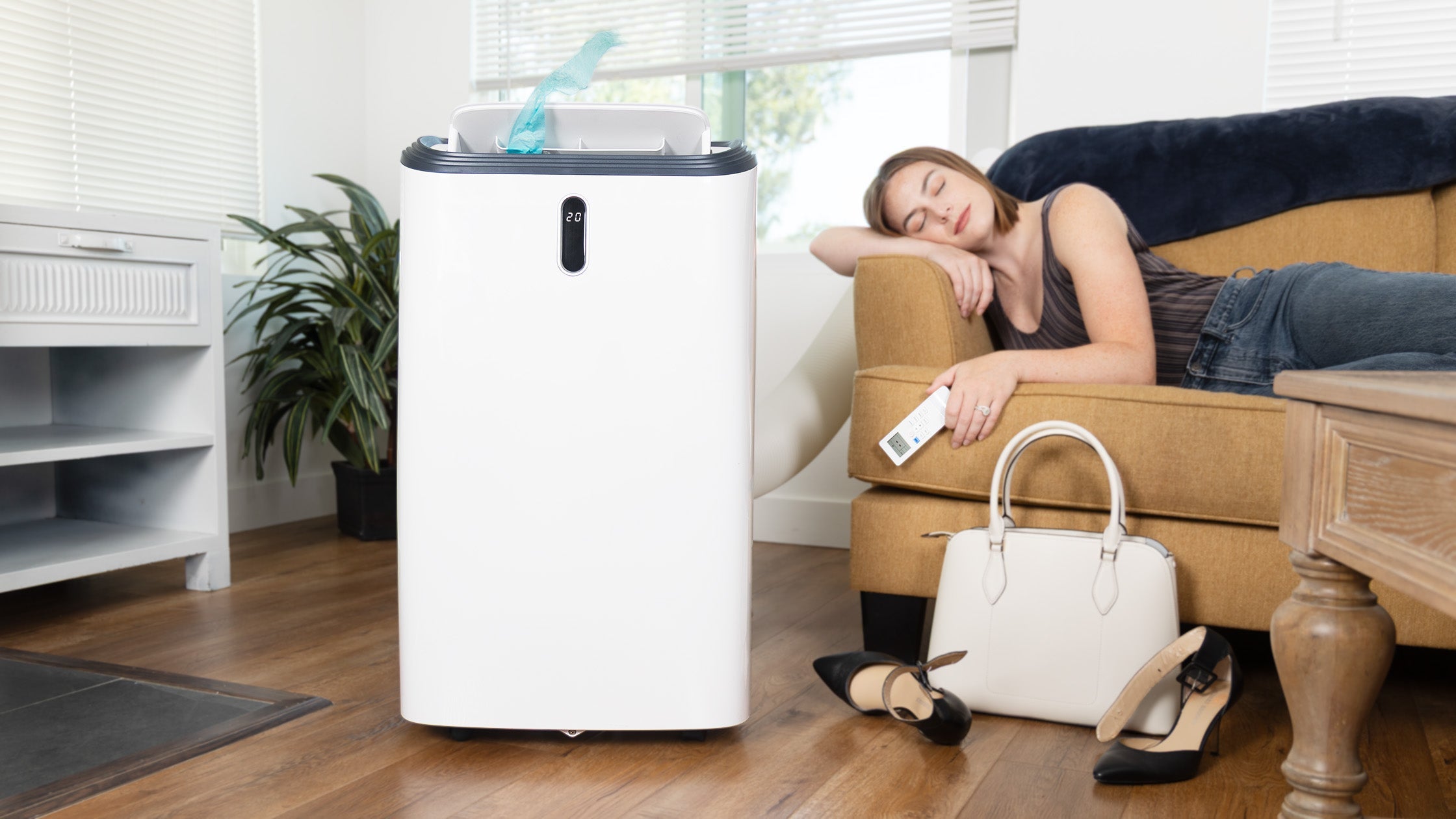
Some of the hottest rooms in a house are the ones with no window to cool them. An interior bedroom, a finished basement, a dorm room with a sealed pane, a home office tucked over the garage. The heat builds all afternoon and a window AC is not an option. Here is the good news: a portable air conditioner does not need a window. It needs a way to send its hot air out of the room. Find that exit and you can cool almost any space.
First, the one thing every portable AC needs
A portable AC does not make heat disappear. It pulls heat out of the room air and pushes it outside through an exhaust hose. That hot air has to leave the room, or it just circles back and reheats the space you are trying to cool. The Department of Energy is blunt about it: a room air conditioner has to reject heat to the outdoors to work.
So "cooling a room without a window" is really one question: where does the exhaust hose go? You have more answers than you think, and only one of them is an actual window.
Five ways to vent a portable AC without a window
1. Vent through a sliding glass or patio door
The fastest no-window option. The adjustable window kit that ships with most portable ACs is built for a sliding track, and a patio door is just a tall vertical version of that track. Slide the panel into the lower section of the door opening, run the hose through the kit's port, and fill any gap above with the extra panel or sealing foam. The ZAFRO EliteCool ships a quick-connect window kit rated for horizontal or vertical sliding windows, so it adapts to a patio-door track out of the box.

2. Vent through a wall
The cleanest permanent fix for a room you cool every summer. Cut a hole the diameter of the exhaust hose, the same way a dryer vent is installed, and fit a wall vent cover on the outside. The hose connects to the wall port and the unit can sit flush against the wall year-round. Best for finished basements and offices where a sliding-door setup is not available.
3. Vent into a dropped ceiling
Common in basements and commercial offices with suspended ceiling tiles. Route the exhaust hose up and over a lifted tile so the hot air dumps into the ceiling plenum and out. One honest caveat: this only works if that ceiling space is itself ventilated to the outdoors. Pushing hot air into a sealed cavity just heats the cavity, and the warmth finds its way back down.
4. Reuse an existing dryer vent
If the room has a dryer hookup you are not using in summer, connect the AC exhaust to the existing dryer vent. You get an outdoor exit that is already cut, sealed, and capped. Match the hose diameter to the vent and confirm the outside flap opens freely.
5. Vent through a door into an adjacent space
The compromise option, and the one to use only when nothing above is possible. Run the hose through a doorway into an attached garage, a large stairwell, or a hallway that can absorb the heat. It is the least efficient method, because that hot air is still inside your building, but it works when the adjacent space is large or vented on its own.
What does not work
The mistake that wastes the most money: leaving the exhaust hose loose inside the same sealed room. With nowhere for the heat to go, the unit runs nonstop and the room never cools. The same goes for a closed closet or any space with no outlet to the outdoors.
If your room genuinely has no path for hot air to leave, a portable AC cannot cool it. In that case a tower fan will move air and make the room feel a few degrees cooler, but it does not lower the actual temperature. Be clear-eyed about which one you need before you buy.

Size the unit to the room
Once you have an exit for the exhaust, match the AC's capacity to the space. A good rule is about 20 BTU of cooling per square foot, then round up to the next size on the market. A 250 square foot bedroom wants roughly 6,000 BTU of real cooling capacity; a 500 square foot basement wants closer to 10,000. Sun, high ceilings, and extra people all push that number up.
For interior bedrooms, dorms, and small apartments, our guide to the best appliances for apartments and dorms covers compact cooling room by room.
The right Zafro portable AC for a windowless room
Every Zafro portable air conditioner ships with an exhaust hose and an adjustable window kit, so the venting methods above work straight out of the box. Here is how the in-stock lineup fits different windowless rooms.
Medium to large rooms, easy venting. The ZAFRO ComfortFlow runs 12,000 to 14,000 BTU and cools rooms up to 550 square feet, with cooling, fan, and dehumidifier modes and a quiet sleep mode at 52 dB or lower. It ships with the exhaust hose, hose connector, window kit adapter, and an adjustable window kit, plus 360 degree wheels to roll it between rooms. Around $500.
Quiet bedroom or office you control by app. The ZAFRO EliteCool delivers 12,000 to 14,000 BTU at just 44 to 46 dB, with WiFi control through the Zafro app, Alexa, and Google Assistant, and energy-efficient R32 refrigerant. Its quick-connect window kit fits horizontal or vertical sliding windows, which makes it the easiest match for a patio-door vent. Around $525.

Large or open spaces that need the most cooling. The ZAFRO Bamboo EliteCool steps up to 14,000 to 16,000 BTU for rooms up to 600 square feet, runs as low as 42 dB in sleep mode, and adds smart WiFi control and R32 refrigerant. It is the quietest unit in the range for a big basement or open living area, and we cover it in detail in why the Bamboo EliteCool is the quiet cooling hero of the summer.
Pick your exit for the exhaust, size the unit to the room, and a windowless space cools just as well as any other. That is the whole trick.
→ Ready to cool the room a window AC cannot reach? Shop portable air conditioners at Rowan Appliance and match the unit to your space.


