

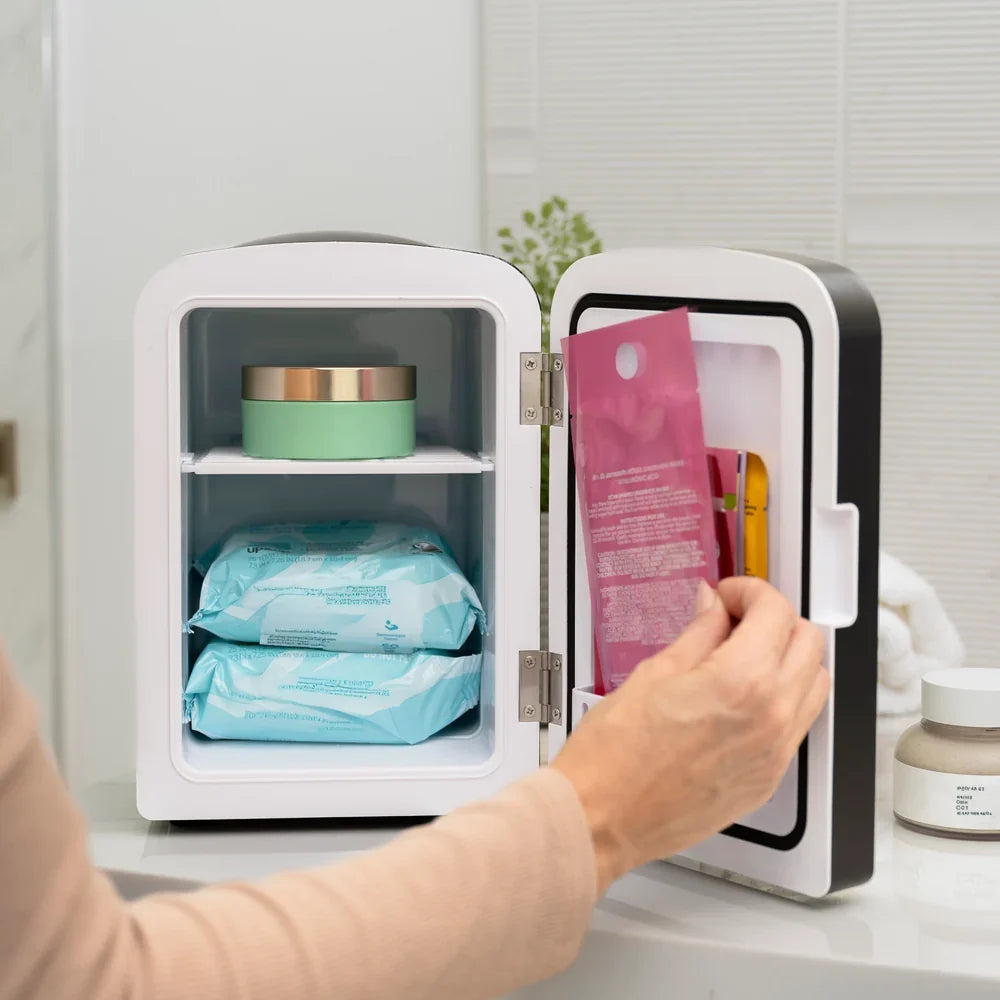
You have seen them on every skincare shelfie: a little fridge, usually under 10 liters, sitting on a vanity next to a ring light. The question is whether it does anything, or whether it is just a nice-looking box for your serums.
A skincare fridge is a small refrigeration unit, typically 4 to 12 liters, built to hold products at a steadier, cooler temperature than your bathroom or bedroom. It is not a substitute for your kitchen fridge and it is not required for most of what is already in your routine. But for a specific short list of products, it earns its counter space.
What a skincare fridge does
A dedicated skincare fridge holds a narrow band, usually somewhere between 40°F and 60°F depending on the model, instead of the 34°F to 40°F a kitchen fridge is built for. That matters because most skincare formulas are not food. Chilling a moisturizer to kitchen-fridge temperatures can separate the emulsion or make a lightweight lotion go thick and hard to spread. A skincare fridge is tuned to cool a product without doing that.
The other real function is consistency. Bathroom counters swing in temperature with your shower, and a nightstand near a window can sit in direct sun half the day. A dedicated unit holds one number, which matters more for a handful of ingredients than most product pages let on.
The products that benefit from cold storage
Cleveland Clinic's dermatology team puts it plainly: most skincare is stability-tested to hold up fine at room temperature, and only a short list of product types show a real benefit from cooler storage.[1] The clearest case is vitamin C. L-ascorbic acid, the active form used in most brightening serums, oxidizes faster above 77°F and holds its potency longest between about 36°F and 46°F.[2] If you paid $40 or more for a vitamin C serum and it turned yellow-brown in three months, heat is the most likely reason, not a bad batch.
Beyond vitamin C, a handful of other categories hold up better cold:
- Eye creams and gel-based products. The cooling itself helps with morning puffiness, and gel formulas do not thicken the way an oil-heavy cream does.
- Sheet masks and hydrogel patches. These are mostly water, so refrigeration does not risk separating anything, and a cold mask feels noticeably better on the skin.
- Aloe-based and soothing gels. Same logic as the eye creams: refrigeration adds a sensory benefit on top of any formula stability.
What does not need to go in there
This is the part most skincare fridge product pages skip, because it is not a great sales pitch: the majority of what is in your routine will not perform any better cold. Retinoids, oil-based serums, thick balms, and most heavier moisturizers are formulated and packaged (often in opaque, airless pumps) specifically so they hold up at normal room temperature. Refrigerating them does not reverse degradation that already happened from an old cap left open, and for oil-heavy formulas, cold can make the product separate or harden enough that you are fighting the packaging every morning.
The honest way to think about a skincare fridge: it is not a universal upgrade for your whole routine. It is the right tool for three or four products, most people already own at least one of.
Skincare fridge vs. a plain mini fridge

Not every cold-storage option needs to be a single-purpose beauty gadget. A few real differences are worth knowing before you buy:
Dual cooling and warming modes. Some units, like the Antarctic Star Retro Mini Fridge, cool down to 32°F below ambient for vitamin C and gel masks, and warm up to 131 to 149°F for the opposite use case: warm oil treatments or a hot towel-style compress. That second mode is genuinely useful and most dedicated "skincare fridges" do not offer it.
Mirror and lighting. If your fridge doubles as part of a vanity setup, a built-in mirror and LED ring, like the one on the 4L Mini Fridge with LED Mirror, turns the unit into part of your routine instead of a box you open and close. It is a real feature for anyone who already does their skincare at a desk or vanity rather than a bathroom sink.
Quiet, compressor-free cooling. Most skincare fridges, including the 10L Mini Fridge, use thermoelectric cooling instead of a compressor. That means no hum and no vibration on a nightstand next to where you sleep, at the cost of a smaller usable temperature swing than a full compressor fridge, which is fine for skincare and not fine for, say, keeping raw food safe.
How to size it for your routine
Skip the capacity marketing and count what you would really store. A 4-liter unit holds one to two serums, an eye cream, and a sheet mask or two: enough for most single-person routines built around vitamin C and eye care. A 10-liter unit adds room for a full sheet mask stash, a second person's products, or drinks and skincare mixed if you want one nightstand fridge instead of two gadgets.
If your routine leans heavily on retinoids, oils, and heavier creams, and only one vitamin C serum needs the cold, you likely do not need the largest model on the shelf. Buy for the three or four products that benefit, not for the whole shelf.
Where it goes
The honest answer is wherever you already do your routine. A vanity or dresser makes the mirrored, lit models worth the extra cost. A nightstand favors the quietest thermoelectric units, since you will hear a compressor cycle on and off a foot from your pillow. A bathroom counter works for anyone who does their whole routine standing at the sink, as long as the unit is rated for the humidity.
Common questions
Does a skincare fridge make products last longer?
For vitamin C, eye creams, and gel-based formulas, yes, cooler storage slows the oxidation that causes those products to lose potency and change color. For most other product types, the shelf life is set by the preservative system and packaging, not the temperature of the shelf it sits on.
Can I just use my kitchen fridge instead?
You can for the products that benefit, but expect thicker creams and lotions to firm up more than you want, and be careful about food odors transferring to open jars. A dedicated unit is tuned warmer than a kitchen fridge for exactly this reason.
Is a warming mode useful, or a gimmick?
It is a real feature if you use oil-based treatments, wax, or a warm compress step in your routine. Warming to the 131 to 149°F range is enough to loosen a thick oil or warm a towel, without needing a separate appliance.
Start with what you already own
Before buying anything, check your own shelf for a vitamin C serum, an eye cream, or a sheet mask stash. If you have at least one of those, a compact fridge earns its space. If your routine is mostly retinoid and oil-based, save the counter space and the money.
Shop the beauty fridge collection to compare the dual-mode, mirrored, and compact options against what your routine needs. If you are stocking a dorm room or a small apartment and want the rest of the room covered too, our apartment and dorm appliance guide covers what else is worth the space.


