

You want to warm up one room without turning up the heat throughout the entire house. So you start shopping for a space heater, only to see a news story about a heater fire and wonder whether buying one is worth the risk.
The truth is a little more complicated than “space heaters are safe” or “space heaters are dangerous.” The difference often comes down to how and where they are used.
The numbers tell a clear story
The National Fire Protection Association tracks home heating fires. Between 2020 and 2024, US fire departments responded to an average of 37,365 home fires per year involving heating equipment, roughly 11 percent of all reported home fires. Those fires caused an annual average of 417 civilian deaths, 1,260 injuries, and $1.2 billion in property damage.1
Space heaters and heating stoves accounted for about 30 percent of those fires, but 73 percent of the deaths and 70 percent of the injuries.1
So under a third of the fires produce nearly three quarters of the deaths.
That ratio says less about how the heaters are built than about where they end up running. A space heater works at night, in a bedroom, close to bedding, while everyone in the house is asleep.
Why space heater fires can be dangerous
A furnace lives in a basement or a utility closet, gets installed by a professional, and sits several feet from anything flammable. A space heater lives wherever somebody is cold.
That means it ends up on carpet, next to a bed, beside a curtain, plugged into an extension cord because the nearest outlet is across the room. It gets knocked by a foot or a pet. It gets left running in an empty room.
Every one of those is a decision, and every one of them is reversible.
Not every space heater carries the same risk

Most safety guidance stops at a list of rules. It rarely mentions that the design you pick changes your risk before you follow any of them.
Oil-filled radiators are the most forgiving. No exposed heating element and no fan. The oil is sealed inside permanently and never needs topping up. The fins get hot, but the surface runs cooler than a glowing element, and there is no air intake to block with a stray blanket. The tradeoff is speed, since they warm a room slowly and stay warm long after shutoff. In a bedroom, where a heater runs longest with the least supervision, that tradeoff is usually the right one. The R.W.FLAME Oil-filled Electric Radiator Heater is $69.99, heats spaces up to 120 square feet, and includes tip-over protection, overheat shut-off, and an ETL certification.
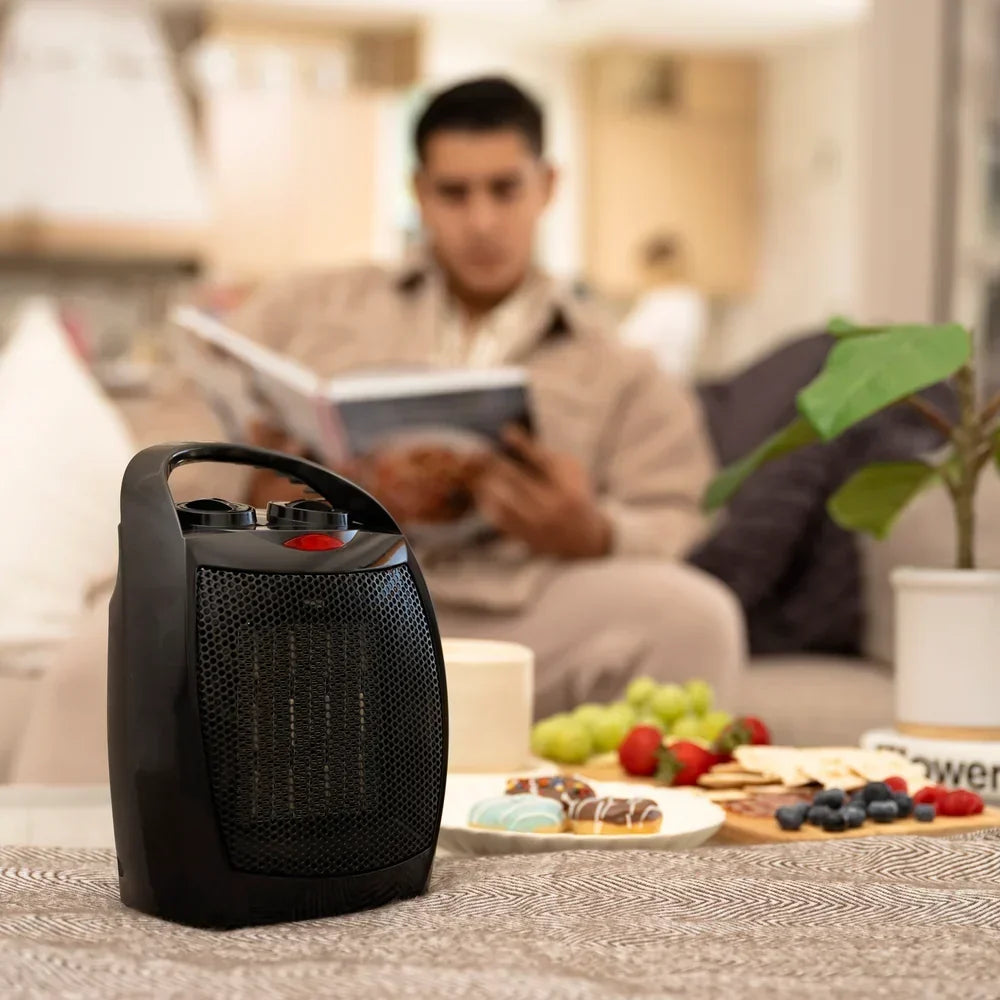
Ceramic fan heaters are fast and need clearance. A fan pulls air across a heating element and pushes it out warm. They heat a room quickly and cool down quickly, which is genuinely safer than a unit that stays hot for an hour. The weak point is the intake. Block it with a towel, a sock, or a couch pushed too close and heat builds inside the housing. The R.W.FLAME Mini Space Heater is $23.00, weighs 2.42 pounds, and runs at 750W, 1500W, or fan only, which suits a desk or a home office better than an overnight bedroom.
Infrared heaters warm objects rather than air. They suit a person sitting still in one place, and models with a cool-touch housing keep hot-surface risk low.
Open-coil heaters are the ones to skip. If you can see a glowing orange coil with nothing in front of it, that is the oldest and least protected design still in circulation. If one is sitting in a garage or a rental, it is the first thing to replace.
Five rules that prevent most problems
Plug it into the wall and nothing else. A 1500W heater draws about 12.5 amps continuously. Household extension cords and nearly every power strip are not rated for that sustained load, which makes the cord the failure point rather than the heater. The Electrical Safety Foundation International is blunt about it: plug space heaters directly into a wall outlet, never an extension cord or power strip, and don't run another device from the same outlet.2
Three feet of clear space in every direction. Papers, clothing, rugs, bedding, curtains, the dog bed. Three feet is the standard clearance figure, and it applies behind and above the unit, not just in front of it.2
Level, hard, flat surface. Not a table, not a cabinet, not thick carpet. A heater on a soft or uneven surface can tip, and tip-over protection is a backstop rather than a plan.2
Off when you leave the room or go to sleep. ESFI's guidance is to never leave a space heater unattended and to turn it off when leaving a room or going to bed.2 Safety cutoffs on a good heater do work. They work best when somebody is awake to notice one has tripped.
Check the cord and plug before each use. A cracked plug, a loose connection, or a plug that feels hot to the touch means resistance somewhere in the connection, and resistance makes heat. Stop using it.2
Can you leave a space heater on overnight?
ESFI's answer is no, and the manuals that ship with most heaters say the same thing.2 The advice is blunt for a reason: overnight is when supervision drops to zero and the heater runs longest.
If you need warmth through the night anyway, the lower-risk setup is a heater with a thermostat and a timer so it cycles and shuts itself off, placed on a hard floor several feet from the bed, plugged straight into the wall. An oil-filled radiator suits this better than a fan heater, because it holds heat after it stops drawing power, so the room stays comfortable while the heater is off.
That is a way to reduce risk, not a green light. The recommendation is still to turn it off.
Sometimes a heater is not the right appliance

If you want the whole living room warmer instead of targeted heat at a desk, a fixed electric fireplace solves the same problem with less to go wrong. It is mounted or heavy enough that it cannot be knocked over, it sits away from bedding, and it does not migrate from room to room. The R.W.FLAME 36-inch Electric Fireplace with Mantel is $309.99 with infrared heat, two heat settings, thermal overload protection, and a cool-touch exterior.
We looked at that category's risks on their own terms in Are Electric Fireplaces Safe?
Where that leaves you
Space heaters earn their reputation through misuse rather than malfunction. The statistics at the top of this page describe extension cords, crowded clearances, and units left running in empty bedrooms.
Give a heater its own wall outlet, three feet of clearance, a hard level surface, and an off switch before bed, and you have closed nearly every path into those numbers.
→ Shop the electric heater collection


