

You do not need a $1,500 machine to make real espresso at home. You need the right machine for how you drink coffee, and a clear read on what the spec sheet is telling you.
The best espresso machine for home use is the one that matches your routine, not the one with the biggest number on the box. If you drink one or two shots on your way out the door, a compact 20-bar machine under $100 will pull a better shot than the pod machine you are replacing. If you grind beans fresh and steam your own milk, you want a built-in burr grinder and a steam wand, which starts closer to $300. If you are chasing café-level control, look for a 58mm portafilter and a pressure gauge, which is where machines cross into the $450 to $700 range.
What the spec sheet is not telling you
Almost every home machine on the market advertises its pump in bar pressure: 15 bar, 20 bar, sometimes higher. That number describes what the pump can generate at full output. It is not the pressure your coffee actually brews at.
Real espresso extracts at roughly 9 bar, a standard that traces back to Achille Gaggia's 1936 patent for the modern espresso machine and has held because it is the pressure at which water moves through the puck fast enough to avoid over-extraction without rushing past the grounds.[1] Every quality machine, home or commercial, uses an over-pressure valve that caps the pressure reaching the coffee at 9 to 10 bar regardless of what the pump is rated for.[1] A 20-bar pump is not brewing at 20 bar. It is a pump with enough headroom to hold a stable 9 bar even as the puck resists it and the machine ages. Treat the bar number as a floor, not a selling point, and judge a machine on its grinder, its steam wand, and its portafilter size instead.
That distinction matters more this year than it used to. Espresso-based drinks reached 45% weekly consumption among US adults in early 2026, the highest share on record. Among people brewing at home, espresso machines now sit close behind cold brew as a preparation method, right behind drip, single-cup, and ready-to-drink.[2] More people are buying their first machine, which means more people are shopping the bar-pressure number without knowing what it means.
The picks, by who is buying

Best value, most popular. The Kismile 20-Bar Espresso Machine is $99.99 and covers the basics without cutting corners that matter. A 1,350W thermoblock heats in seconds, a pre-brew (pre-infusion) step evens out the extraction, and a steam wand handles milk for lattes and cappuccinos. The 1.2L tank and built-in cup warmer are the kind of details that show up in daily use, not on a spec sheet.
Best for a small kitchen. The Kismile Mini Espresso Machine is $89.99 and gives up almost nothing in exchange for the smallest footprint on this list. It runs the same 20-bar pump and pre-soak brewing, with an LED display and knob controls instead of a touchscreen. If counter space is the constraint, this is the machine.
Best for pods and ground coffee. The Kismile 20-bar Compact Espresso Machine is $159.99 and brews both ground coffee and Nespresso-compatible capsules from the same machine. That flexibility matters if two people share a kitchen and one wants control over the grind while the other wants a shot in 20 seconds. A 3-second thermoblock and a 1.4L tank round it out.
Best if you also want cold brew. The Kismile Compact Espresso Machine with Cold Brew Function is $198.54 and adds a cold brew mode to the standard digital display and 20-bar setup. An auto sleep mode keeps it efficient if it is not your only machine running all day.
Best built-in grinder under $350. The Kismile BaristaPro is $329.99 and is the first machine on this list built for someone who wants to dial in their own beans. A conical burr grinder with 30 grind settings and adjustable shot volume gets you real control over extraction, and a built-in frother handles the milk side. It suits someone upgrading from pods who has started noticing the difference fresh grounds make.
Best for the aspiring home barista. The Kismile 15-Bar Espresso Coffee Machine is $459.99 and is the first machine here with a 58mm portafilter, the size commercial cafés use. Cheaper machines ship a smaller pressurized basket that does some of the work for you. A 58mm basket does not, which is why people who want to learn extraction ask for it by name. A 1,500W motor, a clog-resistant grinder with 30 settings, and a stainless steam wand for latte art come with it.
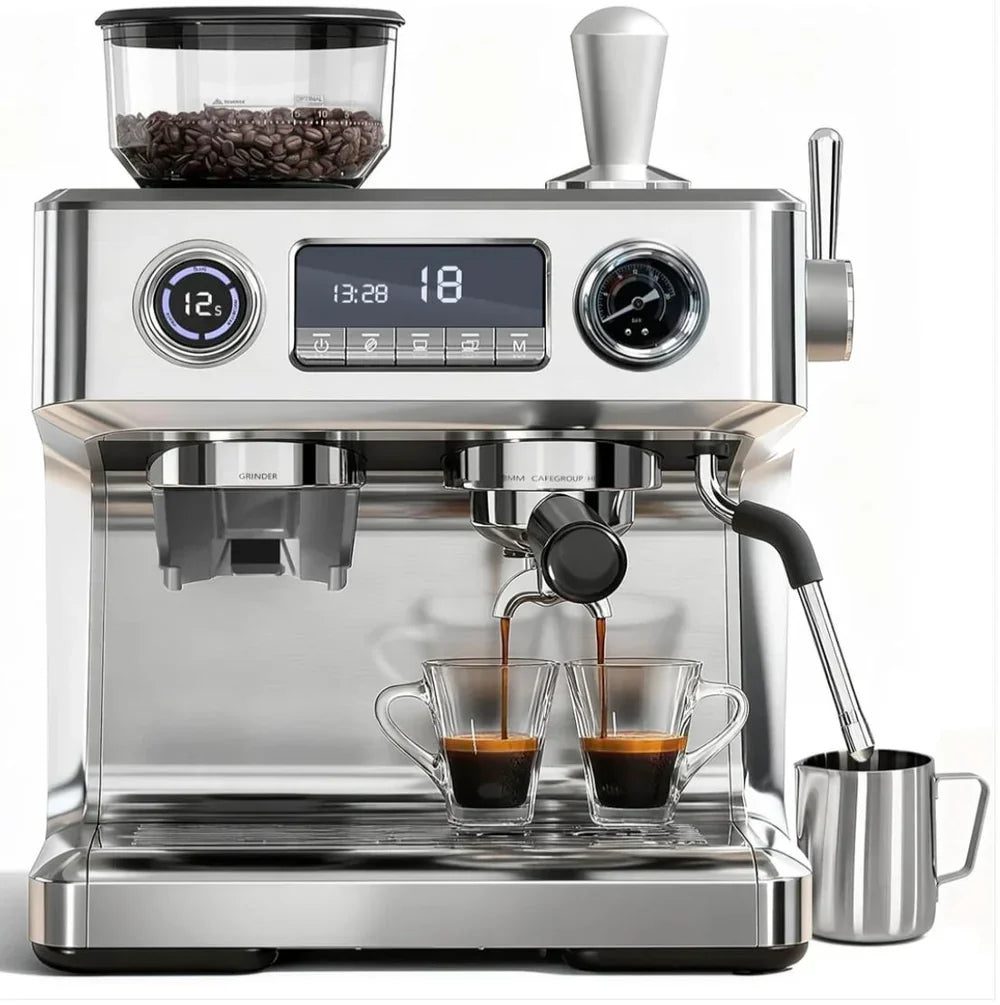
Best all-in-one splurge. The Kismile 20-Bar Espresso Machine with Built-In Grinder is $699.99 and is the most complete machine Rowan carries. A built-in bean hopper and grinder, single and double-cup brewing, a separate hot water outlet for Americanos, and a pressure gauge that shows you the actual extraction pressure in real time, not just what the pump is rated for. It is the machine for someone who has already outgrown the BaristaPro and wants to see the number instead of trusting it.
Espresso machine, or something else
Not everyone who searches "best espresso machine for home" actually wants espresso. If you are deciding between a machine that pulls shots and one that brews a pot, espresso vs coffee breaks down the real differences in grind, brew time, and caffeine per serving. If you are choosing between a single-serve pod system and a drip machine instead, single serve vs drip coffee maker covers that decision directly.

Keeping it running
Every machine on this list needs regular descaling, and skipping it is the single biggest reason a home espresso machine stops producing good shots after a year. How to descale an espresso machine covers exactly how often and what to use, based on your water hardness and how much you brew.
FAQ
Do I need to spend $1,000 or more to get real espresso at home?
No. The 9-bar extraction standard that defines real espresso is present in machines starting under $100 on this list. What changes as you spend more is control: grinder quality, portafilter size, and how finely you can adjust the shot, not whether the coffee is technically espresso.
What is the difference between a semi-automatic and an automatic machine?
A semi-automatic machine, which is most of what is on this list, lets you control the grind, dose, and shot timing yourself. A fully automatic or bean-to-cup machine grinds, tamps, and brews at the press of one button. Semi-automatic gives you more control and a lower price. Automatic gives you speed and consistency with less to learn.
Is a 20-bar machine better than a 15-bar machine?
Not necessarily. Both regulate down to roughly 9 bar at the puck, so the difference is headroom and consistency under load, not shot quality out of the box. Prioritize the grinder, the portafilter size, and the steam wand over the bar number.
Can I use ground coffee and pods in the same machine?
Some can. The Kismile 20-bar Compact Espresso Machine brews both ground coffee and Nespresso-compatible capsules, which is worth knowing if your household is not going to agree on one format.
Match the machine to how you actually make coffee, not the biggest number on the box. Every pick here is in stock and ready to ship.
→ Shop the espresso machine collection


