

Your tower fan ran all night, and this morning the airflow feels like a whisper. Pull it into the light and you'll usually find the reason: a grey mat of dust packed into the intake grille on the back, thick enough to see through only in patches.
Here's how to clean a tower fan. Unplug it, vacuum the intake and exhaust grilles with a brush attachment, wipe the housing with a soft, barely damp cloth, and let it dry fully before you plug it back in. That's the whole job for most fans, and it takes about ten minutes.
The part almost nobody tells you is what comes next. A lot of the advice out there, including the video tutorials that dominate search results, tells you to grab a screwdriver and take the back panel off. For some fans that's fine. For others it will void your warranty and can damage the motor. Which one you own decides everything, so start there.
Check your manual before you take anything apart
This is where most tower fan cleaning guides go wrong, and it matters more than any technique.
Lasko, one of the most common tower fan brands in American homes, is blunt about it. Its operating manual instructs owners to clean the fan only with a vacuum and a brush attachment, and then states plainly: "NEVER attempt to take apart the Fan." The same manual says to clean the body with a soft cloth only, and never to place the fan in or near water.
Vornado takes a similar line on the parts that matter. Its owner's guide tells you to unplug before any cleaning, to use a common household vacuum on the motor housing and inlet ribs, and not to use water on those parts at all. It also notes something worth knowing: the motor is permanently lubricated and never needs oiling. If a video tells you to spray lubricant into the motor, close the video.
Other brands are built differently. Some tower fans, including several Dreo models, are designed with a removable rear grille and the manual walks you through taking it off. That's a real design difference, not a matter of opinion.
So the rule is simple. Find your model's manual, look at the maintenance section, and do what it says. If it tells you not to open the fan, don't open the fan. A vacuum through the grille pulls out more dust than people expect, and it's the method the manufacturers who seal their housings actually recommend.
The ten-minute clean, no disassembly

This works on every tower fan, sealed or not, and it's the one you'll do most often.
- Unplug it. Not the power button. The plug. Every manual leads with this for the same reason: you're about to put a vacuum nozzle against a motor housing.
- Take it outside, or hold a vacuum right at the grille. Dust that comes out has to go somewhere, and the alternative is redistributing it around the room you were trying to make comfortable.
- Vacuum the intake grille. This is the tall vented panel on the back, and it's where nearly all the buildup lives. Use the brush attachment and work top to bottom in overlapping passes. Press gently. The brush is there to loosen dust so suction can lift it, not to scrub.
- Vacuum the exhaust slot. The narrow vertical opening on the front. Less dust collects here, but what does collect sits right in the airflow path.
- Wipe the housing. Soft cloth, barely damp, mild soap if the fan lives in a kitchen. Wring the cloth out until it's almost dry.
- Let it dry completely. Give it an hour before plugging it back in.
If your grille has fine slots and the vacuum can't reach into them, a dry paintbrush or a can of compressed air worked from the inside out will push dust back toward the vacuum nozzle. Keep the vacuum running while you do it.
Can you use water on a tower fan?
No, and this is the mistake that turns a dusty fan into a dead one.
Both manuals are explicit. Lasko says never to place the fan in or near water. Vornado says not to immerse the product in water or allow water to drip into the motor housing. The reason is structural. A tower fan's motor sits directly behind the intake grille, so any water you spray at the grille runs straight into it. There's no barrier and no drainage.
A barely damp cloth on the outer housing is fine. A hose, a sink, a spray bottle aimed at the vents, or a wet cloth that drips are not. Neither is alcohol or solvent. Lasko's manual specifically warns against alcohol, gasoline, benzene and paint thinner, which will haze and crack the plastic even when they don't reach the motor.
If water does get inside, don't run the fan to dry it out. Unplug it and leave it somewhere warm and dry for a couple of days.
Cleaning by brand: what actually differs
The technique barely changes between brands. What changes is whether you're allowed to open the housing, and that's worth knowing before you start unscrewing things.
- Lasko. Sealed. Vacuum with a brush attachment through the grilles, wipe with a soft cloth, and leave the screws alone. Lasko's manual says the vacuum will pull lint and dirt from inside the fan, which is the intended method rather than a compromise.
- Honeywell. Most QuietSet tower fans follow the same pattern: vacuum the rear intake grille, wipe the exterior, no user-serviceable parts inside. Check the manual for your specific model before going further.
- Vornado. Unplug, use a household vacuum on the motor housing and inlet ribs, and keep water away from those parts entirely. Don't oil the motor.
- Dreo. Several models are built with a removable rear panel, and the manual tells you how to take it off. If you own one of these, a deep clean every season is straightforward.
- Holmes and other budget towers. Usually sealed, usually no documented disassembly path. Treat them like a Lasko unless the manual says otherwise.
When in doubt, the vacuum-through-the-grille method is never the wrong answer. It's slower than pulling the case apart, and it will not damage anything.
How often should you clean it?
Once a month during the months you're actually running it, and once more before you put it away for the winter.
That cadence isn't fussiness. A tower fan pulls the room's air through a narrow grille for hours at a stretch, so it collects whatever is floating around: skin cells, textile fibers, pet dander, pollen that drifted in through a window. The EPA notes that particles 10 micrometers and smaller are inhalable, can settle deep in the lungs, and in some cases pass into the bloodstream. A caked grille is both a pile of that material and a machine pointed at your face.
The performance side is simpler. Dust restricts the intake, the motor works harder to move less air, and the fan gets louder while cooling you less. Most people read that as the fan wearing out. Usually it's a filter problem, and the filter is the grille.
When cleaning stops working

Sometimes the fan really is done, and it's worth knowing the difference so you don't keep cleaning a motor that's finished.
Three signs it's past saving. There's a bearing whine or a rattle that stays after a thorough clean. The airflow never comes back to what it was, even with a spotless grille. Or the fan is somewhere north of eight years old and has started cycling itself off, which usually means the thermal cutoff is tripping on a tired motor.
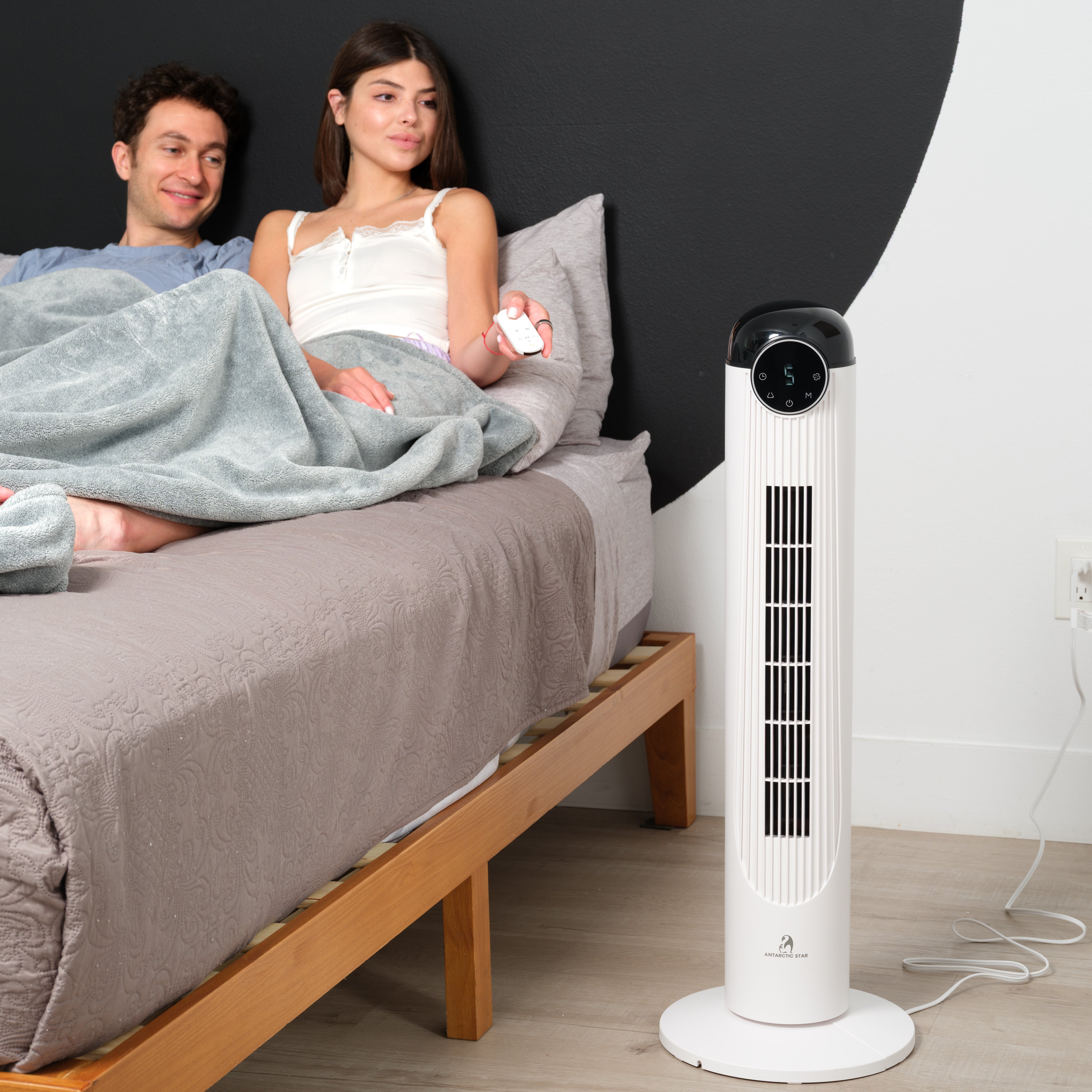
If you're replacing rather than reviving, the thing worth checking is how the fan is built. Rowan's tower fan collection is bladeless, which means there's no exposed blade cage to dismantle and dust down every few weeks. The Antarctic Star 3-Mode Oscillating Tower Fan stands 43.3 inches, sweeps 85 degrees, and runs three speeds and three breeze modes with a timer and remote, at $94.99. If you're cooling a bedroom or a home office and want to spend less, the Antarctic Star Oscillating Tower Fan covers the basics with three speeds and a sleep mode at $49.99.
A fan is only ever part of the answer in a hot room, of course. If yours is fighting a losing battle in July, the real fix might be cooling the room without a window unit or moving up to a portable air conditioner. A clean fan moves air. It can't lower the temperature.
Give yours ten minutes and a vacuum this week. You'll hear the difference before you feel it.


