

Why Is My Portable Ice Maker Not Making Ice? 8 Fixes
Most portable ice maker problems come down to power, water, a false full signal, heat, airflow, or scale. Check them in order from cheapest to most expensive.
Oct 23, 2026

You press the button, the pump hums, and an hour later the basket is empty. Before you assume the machine is dead, know that most "my portable ice maker is not making ice" problems come down to a short list of cheap checks: power, water, a false full signal, heat, airflow, and scale. This guide walks through them in order from free to expensive, so you can stop at the first fix that works and know when the problem is the sealed system instead.
Two notes on sourcing. The manufacturer guidance below comes from two countertop ice maker manuals (an Igloo bullet ice model and a Sharper Image nugget model), not from an Antarctic Star manual. Where something is general appliance knowledge and not from a manual, the text says so. Your own manual wins over any guide, this one included.
Check power and the outlet first because it costs nothing
Confirm the plug is fully seated and the outlet works. Plug in a phone charger or lamp to test it. Avoid extension cords and shared power strips, and try a different wall outlet if you have one. This is general troubleshooting, not a manual quote, but it rules out the one cause that has nothing to do with the machine.
Then press the power button. Many countertop makers sit in standby after you plug them in and do not start until you press it. The Sharper Image guide describes this: after plugging in, the unit enters standby and the ice light flashes until you press the start button.[2]
Fill the reservoir to the MAX line, and no higher
If the pump cannot draw water, the machine stops. The Igloo manual says the ADD WATER light comes on, and the fix is to turn the unit off, fill to the MAX mark, and turn it back on.[1] If the light stays on, turn it off, add water, and restart.[1]
Do not overfill. The Sharper Image guide says the water level in a nugget maker should never rise above the bottom of the ice basket.[2] Use fresh water, and do not let it sit. The same guide says to start each run with fresh water and not let water stagnate inside the unit.[2]
Empty the basket and look at the ice-full sensor
When the basket is full, the machine stops on purpose, and an ICE FULL light turns on.[1] Scoop out the ice and see if production resumes. That is normal behavior, not a fault.
If the basket is nearly empty and the full light is still on, the likely cause is a false full reading. Many portable makers use a sensor beam near the basket to judge how full it is. Ice, water droplets, or a basket that is slightly out of position can block that beam so the machine thinks the basket is full. This is general knowledge from how these sensors work and from competitor support pages. It is not confirmed by either manual we reviewed, so treat it as a check to try, not a guaranteed cause.
What to try:
- Unplug the machine.
- Remove any ice near the basket and wipe the area with a soft, dry cloth.
- Reseat the basket so it sits flat.
- Move the machine out of direct sunlight, which can also confuse some optical sensors.
- Plug in and restart.
Nugget and bullet makers differ a little here. Bullet models drop ice into a basket, so a stuck cluster near it is a common culprit (general knowledge). Nugget models move ice along a different path, so also look for anything jammed in it.
Cool the room, because heat is the most common reason for no ice
An ice maker has to push heat out into the room. A hot room or warm water makes that harder. The Igloo manual says the unit must be in an environment below 90 degrees F, and suggests pouring in colder water between 45 and 90 degrees F if the room or the reservoir water is too warm.[1]
If the machine sits on a sunny counter, near a stove, or in a hot garage, move it. The Sharper Image guide says not to use the ice maker near an oven, radiator, or other heat source.[2] The Rowan product pages for the Antarctic Star ice makers do not list an operating temperature range, so check the manual that shipped with yours for its range.
The reverse can matter too. The Igloo manual says that when the room is below 60 degrees F, you should select the small ice size so cubes do not stick together.[1] That is advice for models with a size selector.
Clear the vents and give the machine space
Blocked vents or dust on the condenser have the same effect as a hot room, since the machine cannot shed heat. That dust point is general knowledge, not from either manual. The Sharper Image guide says to leave 6 inches of space on the top, back, and sides for ventilation, and to keep ventilation openings clear of obstruction.[2]
Pull the machine away from the wall and the cabinet above it, and check the vents with the machine unplugged. If you see dust, remove it with a soft brush or a vacuum on a low setting. Vent location varies by model, so look at your manual's parts diagram.
Descale it, because scale and clogged lines slow or stop ice

Minerals in tap water build up on the evaporator, in the pump, and in the lines. The first sign is usually slower ice, then smaller batches, then none. Rowan's guide to how to clean a portable ice maker walks through the vinegar cycle, including how long a cleaning run takes and how to flush it. Start there: how to clean a portable ice maker.
The Sharper Image guide says to clean the inner liner, tray, water box, and evaporator frequently with a diluted solution of water and vinegar, rinse thoroughly, and dry the inside.[2] It also says the drain plugs on its model need to be inspected and fully seated before use.[2] A plug that is not seated can let water escape and starve the pump.
Using filtered water for the reservoir slows scale. That tip is general appliance knowledge, not from either manual.
Reset it by unplugging, then give it time
A reset clears a stuck cycle. The Igloo manual covers blinking lights: stop the cycle with the power button, unplug the unit, let it sit for a few minutes so ice falls off the evaporator fingers, empty the water tray, and wait three minutes before restarting.[1]
Match the symptom to the fix
| What you see | Most likely cause | Fix to try |
|---|---|---|
| Nothing lights up | No power | Test the outlet, reseat the plug, press the power button. General knowledge. |
| ADD WATER light on | Low water or pump not drawing | Fill to MAX, restart.[1] |
| ICE FULL light on, basket nearly empty | Blocked sensor or misaligned basket | Wipe the sensor area, reseat the basket, restart. General knowledge. |
| Makes ice but very little | Warm room, blocked vents, or scale | Move the machine, clear 6 inches of space, descale.[1][2] |
| Ice forms, then melts or sticks | Room too hot or too cold | Stay under 90 degrees F; use small ice size below 60 degrees F if your model has one.[1] |
| Blinking lights | Interrupted cycle | Power off, unplug, wait a few minutes, wait three minutes, restart.[1] |
| Compressor runs, no ice, nothing above fixed it | Refrigerant leak or blocked cooling line | Contact the maker or a technician.[1] |
A compressor or refrigerant problem is a warranty call, not a home repair
If you changed the water, cooled the room, cleaned the machine, and reset it, and it still makes no ice, the cause may be in the sealed system. The Igloo manual says there may be a refrigerant leak or a blocked pipe in the cooling system, and tells the owner to take the unit to a qualified technician.[1] The Sharper Image guide also warns not to turn the unit upside down, because that may damage the compressor and sealed system.[2]
Do not open the case yourself. Check your purchase date and the warranty. Rowan includes a 1-year limited warranty on new products, starting from the purchase date, covering defects in materials or workmanship and electrical and mechanical failures under normal residential use.[3] It does not cover misuse, improper installation, or failure to follow instructions.[3] Rowan also offers extended coverage that must be purchased within 30 days of the original order.[3] Contact the Rowan customer care team with your order number before you ship or pay for a repair.
How long does a countertop ice maker last, and does the same advice apply to other brands?
We found no manufacturer lifespan figure, so we will not invent one. Lifespan depends on how often you run it, how hard your water is, and how well you clean it, and the 1-year warranty above is the only term we can state.
If your Frigidaire, Igloo, or other nugget maker is not making ice, the same order applies: power, water level, ice-full sensor, room temperature, airflow, scale, reset, then the sealed system. Use that brand's manual for its exact light names and reset steps.
Buying a replacement or a second ice maker
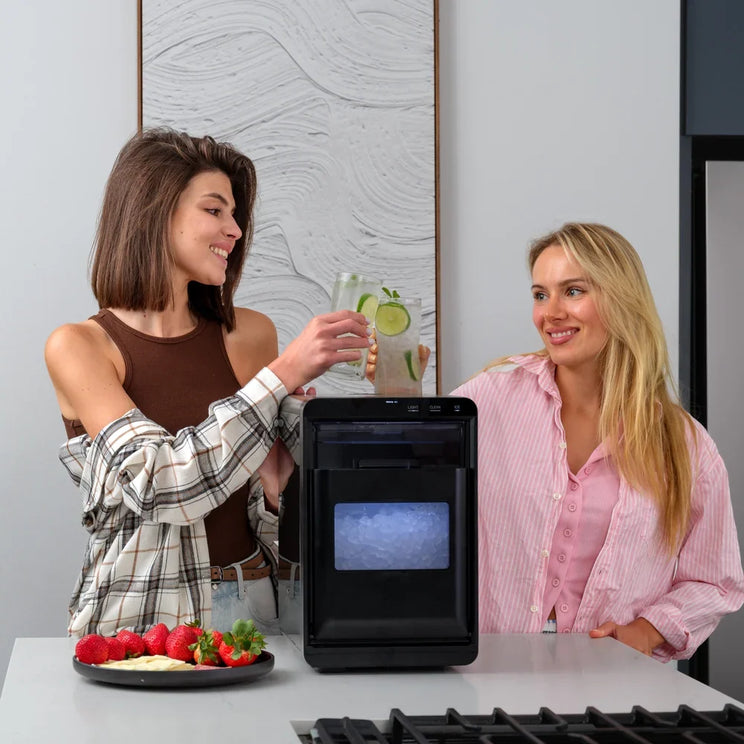
If your machine is past its warranty and the sealed system is the problem, a replacement may cost less than a repair. Browse the full ice maker collection, or look at the Antarctic Star Countertop Nugget Ice Maker, which the product page lists at up to 33 lbs of nugget ice a day with a self-cleaning function. Not sure whether nugget or bullet suits you? Read nugget vs bullet ice.
More from Rowan

Get the Rowan newsletter
New guides, product news and offers, straight to your inbox.
