

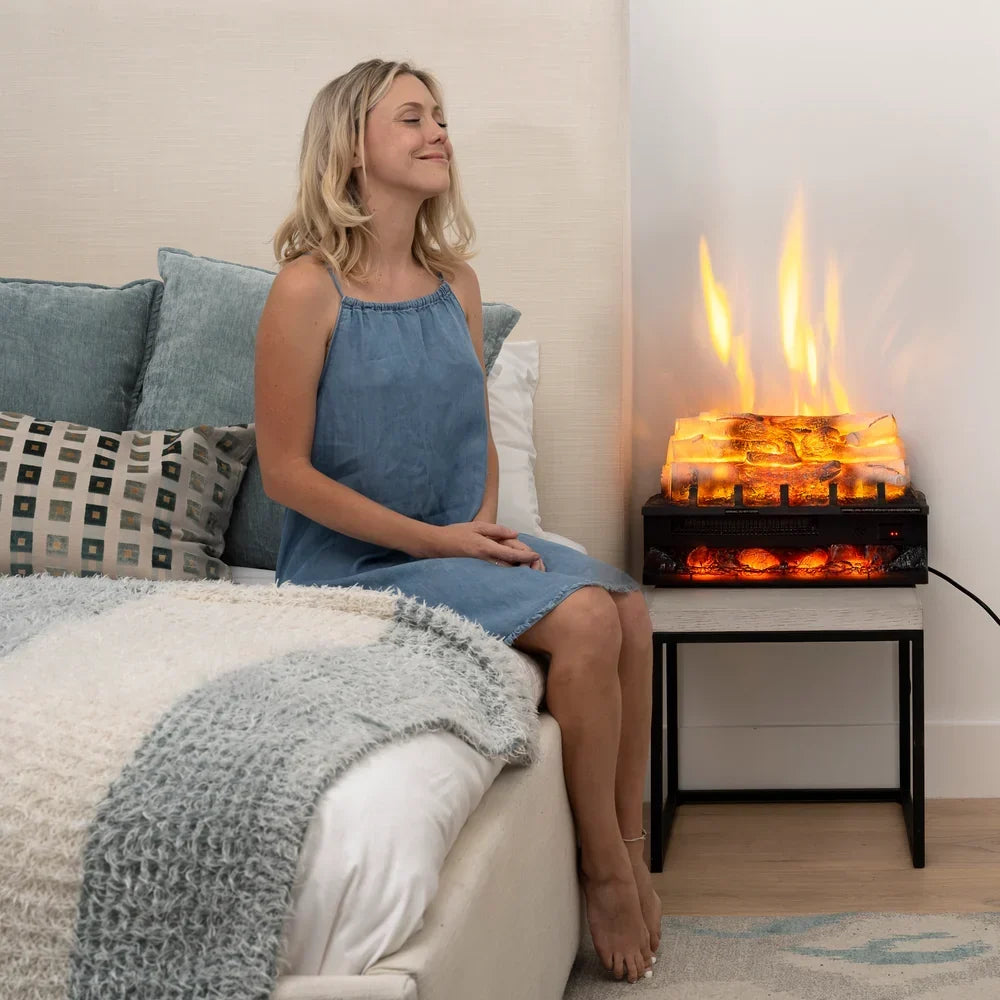
An electric fireplace insert is one of the few home upgrades you can finish in an afternoon. The catch is that most installs that go wrong go wrong before the box is even open. The opening got measured once instead of twice, or the outlet behind the firebox is already carrying half the living room.
Electric fireplace insert installation comes down to four checks: the size of the opening, the circuit that feeds it, what you do with the damper, and where the cord runs. Get those right and the rest is a screwdriver and twenty minutes. Skip them and you are paying for return shipping or an electrician.
Three install types, three different jobs
"Insert" gets used for three products that install nothing alike. Sort out which one you are buying first, because the work is not comparable.
A plug-in log set drops into an existing masonry firebox. You do not cut anything or fasten anything to the wall. You set it on the floor of the firebox, run the cord out, and plug it in. The R.W.FLAME Electric Fireplace Insert Log Heater is this type, a 20-inch log set at $129.99 with two heat settings, adjustable flame brightness, and a remote. One person can do it in under thirty minutes.
A recessed or wall-mount unit goes into a framed opening or hangs flat on the wall. Recessing one into a wall is real carpentry. Hanging one flat is a two-person afternoon. The R.W.FLAME Wall-Mount/Recessed Electric Fireplace comes in 30, 36, 42, 50, 60 and 68 inch widths, so fitting your opening is a measuring decision rather than a compromise.
A freestanding mantel unit installs by being carried into the room. The 36-inch R.W.FLAME with mantel is firebox and surround in one piece. If you want the look without opening a wall, stop reading at the circuit section. The rest does not apply to you.
Measure the opening twice, and measure the depth
Width is the number everyone checks. Depth is the number that sends units back.
For a plug-in log set going into an existing firebox, measure three things:
- Front width at the opening, and rear width at the back wall of the firebox. Masonry fireboxes taper. A log set that clears the front can jam four inches in.
- Height at the lowest point of the opening, usually the top of the front lintel, not the center of the arch.
- Depth from the front edge of the hearth to the back wall.
Leave yourself half an inch to an inch of clearance on the sides and back. You want to be able to lift the unit back out without scraping brick, and you want air moving around the housing.
For a recessed install, the number that matters is the rough opening in the framing, not the trim dimension on the product page. Frame it to the manufacturer's spec sheet, then dry-fit before you close up the drywall. That order saves the whole job.
The circuit is where these installs fail

Almost every electric fireplace on the market runs 1,500 watts on high. On a 120-volt circuit, that is 12.5 amps.
A standard 15-amp household circuit is rated for 1,800 watts, which looks like plenty. It is not. The National Electrical Code treats anything running longer than three hours as a continuous load and limits it to 80 percent of the breaker rating.[1] On a 15-amp circuit, that ceiling is 12 amps. Your fireplace wants 12.5.
That gap is why a fireplace that seems fine for an hour trips the breaker on a cold evening, and it is why the wiring behind the wall runs warmer than it should.
What to do about it:
- Best case: a 20-amp dedicated circuit. Twelve and a half amps is comfortable inside a 16-amp continuous ceiling, and nothing else is competing for it.
- Workable: a 15-amp circuit with nothing else drawing on it. Not to code as a continuous load, but far better than sharing. Find the breaker, switch it off, and see what else in the room goes dark before you commit.
- Not an option: an extension cord or a power strip. The Electrical Safety Foundation International is blunt about this. Heaters go directly into a wall outlet, because most cords and strips are not built for a sustained 12.5-amp draw.[2]
If your firebox has no receptacle nearby, that is the one part of this job worth paying for. An electrician adding a dedicated 20-amp line and a receptacle inside the firebox is a couple of hours of work, and it makes every future insert you own a plug-in job.
You can also sidestep the whole question by running the unit on low. Most electric fireplaces, including the R.W.FLAME wall-mount, split into a 750-watt low setting and a 1,500-watt high. At 750 watts you are pulling 6.25 amps and nothing on the circuit cares.
Seal the damper, or you are heating the sky
An electric insert does not burn anything, so it does not vent. That means the chimney above it has no job left except moving your heated air outdoors.
Close the damper. Then seal it, with a chimney balloon, a rigid damper plate, or fireproof insulation packed into the throat. An open damper on an unused chimney is a permanent hole in your ceiling.
Two things to keep in mind while you do it. Leave the seal removable and leave a note, in case a future owner wants the wood-burning fireplace back. And do not seal a chimney that is still venting anything else, like a furnace or water heater flue sharing that stack. If you are unsure what else is tied into the chimney, that is a question for a certified chimney professional before you plug anything.
Cord routing and the last twenty minutes
Once the unit is in the opening:
- Level it. Shims under the front feet on a sloped hearth. A log set sitting at an angle throws the flame effect off noticeably.
- Route the cord out a bottom corner or the side, never pinched between the housing and the masonry. Pinched cords are the single most common cause of an insert that dies in its second season.
- Plug it directly into the wall. See above.
- Test on high before you trim anything out. Run it fifteen minutes. Confirm the heater kicks in, the flame effect cycles, and the breaker holds.
- Fit the surround or trim kit last, once you know the unit works.
Do you need an electrician, and what does it cost
If a suitable receptacle already exists near the firebox, no. A plug-in log set is a homeowner job and the manufacturer intends it to be one.
You need an electrician when any of these are true: there is no outlet within reach of the cord, the existing circuit is shared with a room's worth of other load, you are hardwiring rather than plugging in, or you are recessing a unit into a wall and want the receptacle inside the cavity. Local permit rules vary, and a new branch circuit generally needs one.
For the fireplace itself, the range in the R.W.FLAME line runs from $129.99 for the log set to $297.48 for the 68-inch wall-mount unit. Compare that to the venting, gas line, and permitted labor a combustion fireplace needs and the install budget is not a contest.
Common problems after install, and what causes them
The breaker trips after an hour. Circuit is shared or undersized. Run on low, or move the unit to its own circuit.
The heater blows cool air. Most units run flame-only by design and only engage the element when the room is below the set temperature. Check the thermostat setting before you assume a fault.
The flame effect flickers oddly or dims. Usually a voltage drop from an extension cord. Plug directly into the wall.
It shuts off by itself. Thermal overload protection doing its job, which means airflow around the housing is blocked. Pull it forward an inch and check that the intake is clear of ash and debris.
A faint burning smell for the first hour. Normal on first run, that is dust and manufacturing residue on the heating element. If it persists past the first couple of hours, unplug it. We go through the rest of the risk list in are electric fireplaces safe.
Where to start
Measure your firebox tonight. Front width, rear width, height at the lintel, and depth. Then find the breaker for the nearest outlet and see what else it feeds. Those two numbers decide everything else.
If your opening is a standard masonry firebox and you want the fastest path to a working fire, the R.W.FLAME Electric Fireplace Insert Log Heater at $129.99 is the one to start with. If you are building the fireplace into a wall, size up from the wall-mount and recessed range.
Either way, browse the full electric fireplace collection and match the width to the opening you just measured.
→ Shop the electric fireplace collection
→ See the R.W.FLAME insert log heater


