

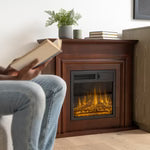
Most comparisons of electric fireplace vs gas fireplace end in a shrug about "personal preference." There is a better answer than that, and it is not the one either industry likes to lead with.
Gas makes cheaper heat. Electric makes cheaper fire. Once you know which of those two things you are shopping for, the decision stops being close.
Start with the only structural question
Is there a gas line at the wall where you want the fireplace?
If yes, gas is worth pricing out and the rest of this article is worth reading closely. If no, the conversation is effectively over. Running a new gas line and a vent through an exterior wall is a permitted job involving a licensed installer, framing work, and a schedule. An electric unit needs a 120-volt outlet.
That single fact decides this for most apartments, condos, rentals, finished basements, and any room that is not already adjacent to existing gas.
What each one costs per hour
Here is the arithmetic, using current national averages.
Electricity ran 18.44 cents per kilowatt-hour in May 2026.[1] Residential natural gas ran $13.96 per thousand cubic feet in January 2026, which is the number that matters because that is when you burn it.[2] A cubic foot of natural gas carries about 1,036 Btu.[3]
| Electric fireplace | Gas fireplace | |
|---|---|---|
| Typical output | 1,500 W (5,118 Btu/hr) | 30,000 Btu/hr input |
| Fuel used per hour | 1.5 kWh | About 29 cubic feet |
| Cost per hour | About 28 cents | About 40 cents |
| Heat delivered to the room | All of it | Roughly 70% on a direct-vent unit |
The obvious conclusion from that table is the wrong one. Yes, the electric fireplace costs less per hour. It also produces about one sixth as much heat. Those are not two versions of the same appliance. One is a supplementary heater and the other is closer to a small furnace.
Per unit of heat, gas wins by a lot

Convert both to the same unit and the picture flips.
- Natural gas: $13.96 per thousand cubic feet works out to about $13.47 per million Btu burned. At roughly 70% efficiency on a direct-vent unit, that is about $19 per million Btu delivered into the room.
- Electricity: at 18.44 cents per kWh, a million Btu costs about $54. Electric resistance heat is 100% efficient at the point of use, so all of that reaches the room, but the input price is high enough that it does not save you.
Electric heat costs roughly two and a half to three times what gas heat costs. If your goal is to take load off a furnace and warm a large room all winter, gas is the cheaper machine to run, and it is not close.
Per evening of ambiance, electric wins by more
Most people are not buying a fireplace to carry the heating load. They are buying it for the evenings. A gas fireplace has one mode. The fire is the heat. You cannot have the flame in July, and you cannot have it in a room that is already comfortable, because within twenty minutes it will not be.
An electric fireplace separates the two. The LED flame effect draws around 15 watts, which is about a third of a cent per hour. You can run the look every evening from October through March for roughly the price of a cup of coffee, and switch the 750-watt or 1,500-watt element on only when the room is actually cold. We worked through the full seasonal math in what an electric fireplace costs to run.
If what you want is a fire in the room on a Tuesday in September, gas has no answer at any price.
Installation is where the money goes
Running cost is the small number. Install is the big one.
A gas fireplace needs a gas line, a vent or chimney liner, a licensed installer, and in most jurisdictions a permit and an inspection. It is a project measured in days and quotes.
An electric fireplace needs an outlet. The R.W.FLAME Electric Fireplace Insert Log Heater at $129.99 drops into an existing masonry firebox in under half an hour. The wall-mount and recessed range runs from $130.66 for the 30-inch up to $297.48 for the 68-inch, and hanging one is an afternoon with a second pair of hands. The 36-inch model with mantel at $309.99 installs by being carried into the room.
The one thing worth checking before you buy is the circuit, because 1,500 watts is 12.5 amps and a shared 15-amp circuit will not hold it through a cold evening.
Safety: the glass is the real difference
The glass front of a gas fireplace commonly reaches 400°F, roughly an oven on broil, and it sits at exactly the height a toddler steadies themselves against. The Consumer Product Safety Commission has been warning about these burns for years.[4] Since January 1, 2015, newly manufactured vented gas fireplaces have been required to ship with a protective barrier if the glass exceeds 172°F.[5] If your gas fireplace predates that, it almost certainly does not have one, and an aftermarket screen is not optional.
A gas fireplace also burns fuel in your house, which means combustion byproducts, a vent that has to keep working, and carbon monoxide as a failure mode.
An electric fireplace has none of that. There is no combustion, no vent, no carbon monoxide, and units like the R.W.FLAME mantel model use a cool-touch exterior and thermal overload protection. It is still a 1,500-watt heater and it still deserves clearance and a proper circuit, which is a different and much shorter list of concerns. We went through it honestly in are electric fireplaces safe.
Maintenance over ten years
Gas: NFPA 211 calls for the venting system to be inspected at least once a year, and that applies to gas appliances, not just wood.[6] Budget an annual service visit, plus the occasional pilot assembly, thermocouple, or blower.
Electric: wipe the glass. Vacuum the intake once a season so the thermal cutoff is not tripping on dust. The LED flame assembly outlasts the rest of the unit.
Over a decade, the annual inspections alone can approach the purchase price of an electric fireplace.
Where electric loses
Heat output. 5,118 Btu per hour is a supplementary heater for a room up to about 400 square feet. A gas fireplace at 30,000 Btu heats an open floor plan. If you need real heating capacity, electric will disappoint you.
Power outages. A gas fireplace with a standing pilot works when the grid is down. That is a legitimate reason to choose gas in areas with unreliable winter power, and no electric unit answers it.
Flame realism at close range. LED flame effects have improved enormously and look convincing from across a room. From three feet away, in daylight, a real flame still reads differently.
Resale perception. In some markets a built-in gas fireplace is a listed feature. An electric unit generally is not.
Which one belongs in your room
Choose gas if you have an existing gas line, you are heating a large or open space, you want the fireplace to displace real furnace load, and you are prepared for a permitted install plus annual servicing.
Choose electric if there is no gas line, you are in an apartment or condo, you want the fire more often than you want the heat, you have young children, or you want the whole thing finished this weekend for the price of the gas installer's site visit.
For most rooms in most homes, the second list is the one that describes the actual situation.
Start by measuring the wall or the firebox opening, then match a width from the electric fireplace collection. If you already have an unused masonry fireplace, the insert log heater turns it back into a working centerpiece tonight.
→ Shop the electric fireplace collection
→ Compare wall-mount and recessed sizes
Sources
- US Energy Information Administration, Electric Power Monthly Table 5.3, residential price May 2026
- US Energy Information Administration, price of natural gas delivered to residential consumers, January 2026
- US Energy Information Administration, Btu heat content of natural gas
- Consumer Product Safety Commission on glass-front gas fireplace burns
- Consumer Product Safety Commission, barrier standard for vented gas fireplaces
- NFPA 211, Standard for Chimneys, Fireplaces, Vents, and Solid Fuel-Burning Appliances


